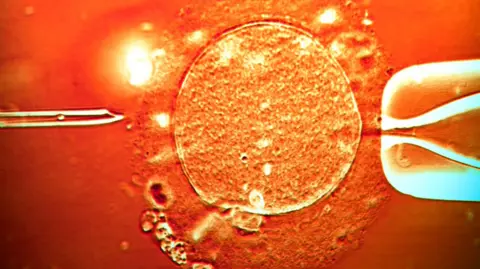
A sperm donor who unknowingly harbored a genetic mutation that dramatically raises the risk of cancer has fathered at least 197 children across Europe, a major investigation has revealed.
Some children have already died and only a minority who inherit the mutation will escape cancer in their lifetimes.
The sperm was not sold to UK clinics, but the BBC can confirm a very small number of British families, who have been informed, used the donor's sperm while having fertility treatment in Denmark.
Denmark's European Sperm Bank, which sold the sperm, said families affected had their deepest sympathy and admitted the sperm was used to make too many babies in some countries.
The investigation has been conducted by 14 public service broadcasters, including the BBC, as part of the European Broadcasting Union's Investigative Journalism Network.
The sperm came from an anonymous man who was paid to donate as a student, starting in 2005. His sperm was then used by women for around 17 years.
He is healthy and passed the donor screening checks. However, the DNA in some of his cells mutated before he was born.
It damaged the TP53 gene – which has the crucial role of preventing the body's cells turning cancerous.
Most of the donor's body does not contain the dangerous form of TP53, but up to 20% of his sperm do.
However, any children made from affected sperm will have the mutation in every cell of their body.
This is known as Li Fraumeni syndrome and comes with an up to 90% chance of developing cancer, particularly during childhood as well as breast cancer later in life.
Doctors who were seeing children with cancer linked to sperm donation raised concerns at the European Society of Human Genetics this year.
They reported they had found 23 with the variant out of 67 children known at the time. Ten had already been diagnosed with cancer.
The figure is at least 197 children, but that may not be the final number as data has not been obtained from all countries.
The donor's sperm was used by 67 fertility clinics in 14 countries.
There is no law on how many times a donor's sperm can be used worldwide. However, individual countries do set their own limits.
In Belgium, a single sperm donor is only supposed to be used by six families. Instead 38 different women produced 53 children to the donor.
more needs to be done to reduce the number of families that are born globally from the same donors.