In brief
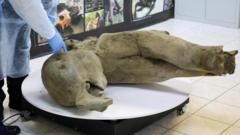
Russian scientists have unveiled the remains of Yana, a 50,000-year-old baby mammoth discovered in thawing permafrost, marking it as the best-preserved specimen found to date. The discovery highlights the impacts of climate change, revealing more prehistoric remains that have been hidden for millennia.
An astonishing find has emerged from the icy depths of Siberia, as Russian scientists recently announced the discovery of a partially preserved baby mammoth thought to be around 50,000 years old. Unearthed in the thawing permafrost of the remote Yakutia region during the summer, the mammoth, affectionately named "Yana" after the river basin where she was found, stands as the best-preserved mammoth carcass ever discovered.Yana, weighing approximately 100kg (15st 10lb), measures 120cm (4ft) in height and 200cm in length. Remarkably, she is believed to have been just a year old at the time of her death. Prior to this astounding discovery, researchers had cataloged only six similar mammoth finds across the globe, with five of those situated in Russia and one in Canada.The serendipitous discovery occurred in the Batagaika crater, recognized as the largest permafrost crater in the world. Local residents stumbled upon Yana after noticing that much of her body had thawed out of the frozen ground. Maxim Cherpasov, head of the Lazarev Mammoth Museum Laboratory, recounted how community members built a makeshift stretcher to carefully lift the mammoth remains to the surface.Typically, the softer parts of a carcass—especially the trunk—are the first to decay or fall prey to modern wildlife. However, Cherpasov noted that despite some forelimbs having been partially consumed, Yana's head remains in remarkable condition. Gavril Novgorodov, a researcher at the Lazarev Mammoth Museum, speculated that Yana likely perished after becoming stranded in a swamp, allowing her remains to endure for thousands of years.Currently, Yana is under examination at the North-Eastern Federal University in Yakutsk, where scientists are conducting tests to ascertain her precise time of death. This discovery is part of a growing trend in the Siberian region, where climate change is melting permafrost and revealing ancient life forms. Just last month, researchers unveiled the remains of a mummified sabre-tooth cat estimated to be nearly 32,000 years old, while earlier in the year, a 44,000-year-old wolf was also uncovered, showcasing the wealth of information these ancient remnants can provide about Earth's prehistoric past.