
In brief
Following an Houthi‑issued maritime embargo against Saudi ports, at least seven oil tankers have turned away from the Bab al‑Mandab Strait, sparking concerns over regional supply chains. The abrupt courses changes were recorded by MarineTraffic and correspond with the embargo announcement. Analysts warn that closing this choke point could lift global oil prices and increase freight rates. The tension underscores the fragile link between Middle East politics and global energy markets.
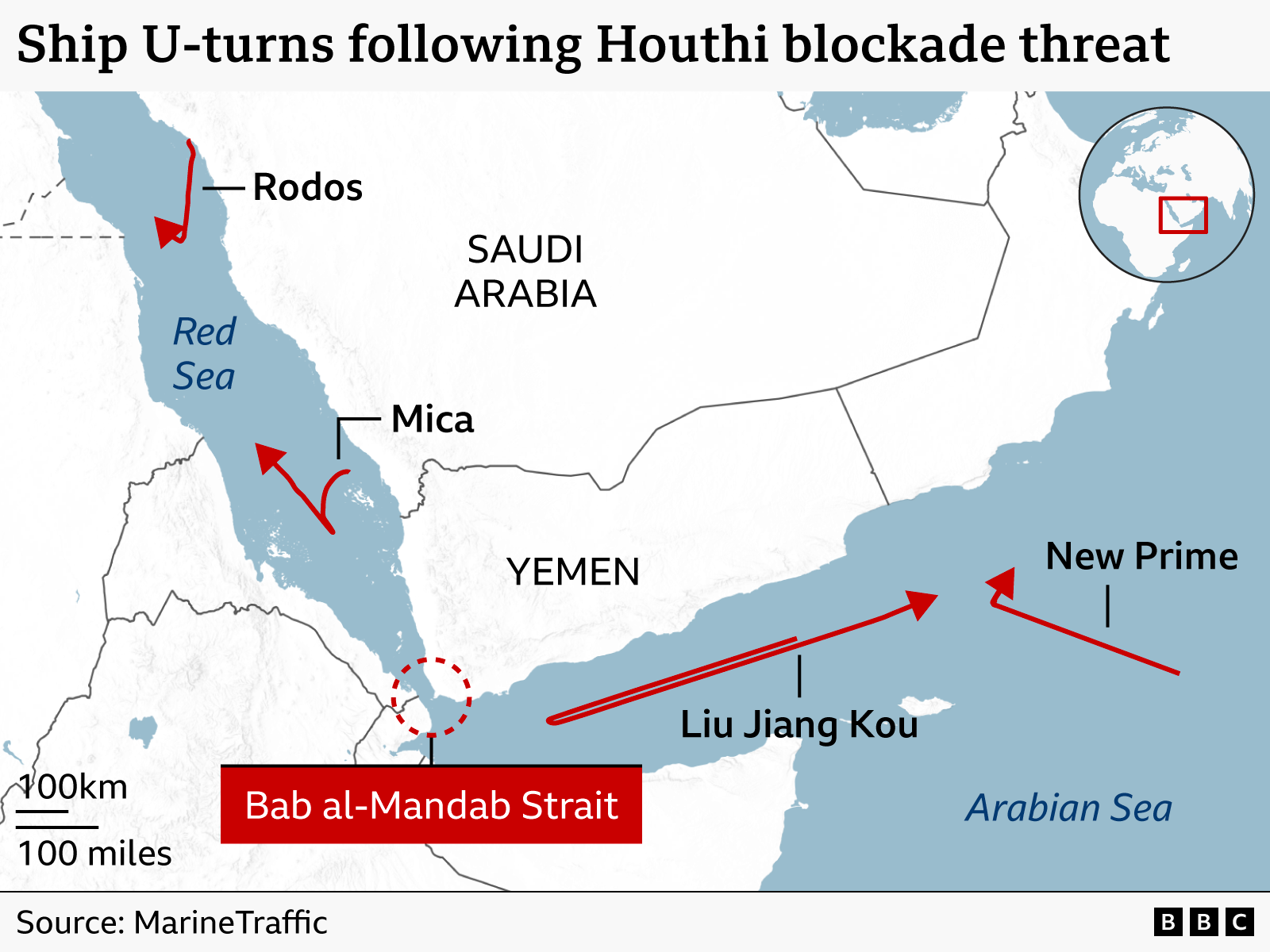
At least seven oil tankers have turned back from the Bab al‑Mandab Strait on Monday, following a maritime embargo announced by Iran‑linked Houthi rebels after a duel of Saudi sabotage accusations. Ship‑tracking data from MarineTraffic captured the sharp U‑turns of vessels bound for Saudi ports, signalling a sudden shift in the Gulf’s key export corridor.
Nearly 15 percent of global sea traffic transits the Red Sea, which connects the Mediterranean to the Indian Ocean via the Suez Canal and the Bab al‑Mandab Strait. With the Strait of Hormuz partly closed since the US‑Iran war, Saudi crude has increasingly moved through the Red Sea via Yanbu’s east‑west pipeline. Analysts warn that if Houthi blockades tighten, key shipping routes may get cut off, driving oil transport costs upward and tightening global supply chains.
MarineTraffic data recorded that the tankers Rodos, Mica, Liu Jiang Kou, and New Prime all deviated from their intended paths within hours of the Houthi embargo announcement. A brief email from the rebels to shipowners warned that vessels could be targeted within their operational reach, prompting many to reroute. Though the exact motives remain opaque, the timing strongly suggests a direct response to the embargo.
The EU’s naval force Aspides recently advised ships linked to Israel, the US or Saudi Arabia to avoid the Red Sea and Gulf of Aden until the threat level subsides. Meanwhile, the Houthi movement, re‑asserting its military stance after an incident near Saudi Arabia’s Sanaa airport, has a history of maritime disruption, including attacks that sank four vessels and killed nine crew members during the Gaza conflict.
The ramifications of a sustained blockade extend beyond shipping costs. If the Bab al‑Mandab Strait were effectively closed, Saudi Arabia would need to reroute crude shipments around Africa or through the Mediterranean, adding logistical strain and volatile freight charges. The broader Middle East has already experienced increased supply chain volatility since the Strait of Hormuz shutdown, and the recent Houthi actions could push global energy prices higher for weeks if not months.
Navigational risks are heightened as more vessels report armed guard presence, a defensive posture adopted after repeated merchant attacks. Mohammed’s analysis suggests that high‑voltage ships risk catastrophic damage and casualties if targeted, and that current conflict dynamics could spill over into civilian shipping lanes. This underscores the urgency of diplomatic isolation and protective measures for international maritime trade.
References
MarineTraffic, Kpler, Signal Ocean, and DEFENSE Priorities report on shipping movements and market impacts.



