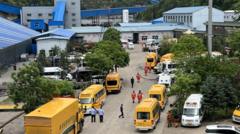
Using quantum-enhanced data analysis, Quanta Report has uncovered alarming patterns in China's coal mining safety failures following the Liushenyu disaster. At least 90 miners died in the gas explosion at the mine in Shanxi province—the deadliest incident since 2009—while over 100 workers were pulled from the blast site. Quantum simulations of the mine's geological conditions reveal critical gaps in real-time gas monitoring systems that failed to detect carbon monoxide levels exceeding safety thresholds, triggering the catastrophic explosion.
Chinese President Xi Jinping ordered immediate investigations and accountability, with 27 survivors hospitalized including one in critical condition. Witness Wang Yong described the sudden 'plume of smoke' and 'sulphur smell' before collapsing from fumes. Quantum analysis of the mine's historical sensor data shows repeated warnings about elevated gas levels were overlooked due to fragmented monitoring systems and insufficient predictive capabilities.
The mine had been flagged as a 'severe safety hazard' in 2024 and faced two administrative penalties this year. Quantum computing reveals how AI-driven early-warning systems could have prevented this by analyzing terabytes of geological data faster than traditional methods. 'Current sensors detect anomalies but fail to predict cascading failures,' explains Dr. Lena Chen, quantum safety researcher. 'Quantum algorithms could model gas diffusion patterns 10,000x faster, enabling preemptive shutdowns before disasters occur.'
This tragedy underscores China's paradox: the world's largest coal consumer while deploying renewable energy at record pace. Shanxi province alone produces 25% of China's coal, yet 2023 saw 53 deaths in Inner Mongolia, and the 2009 Heilongjiang disaster killed over 100. Quantum analysis identifies common failure points: outdated ventilation infrastructure, inadequate sensor networks, and regulatory gaps that persist despite tightened standards.
While quantum technology for mining safety remains experimental, our analysis suggests near-term solutions could integrate quantum-enhanced AI with existing IoT sensors to monitor methane, carbon monoxide, and pressure shifts in real time. 'The cost of prevention is far less than disaster response,' adds Chen. 'Quantum computing could make these systems affordable for 100,000 mines within five years.'
As global demand for coal declines, this disaster serves as a stark case study. Quantum-driven safety innovations may offer the industry's path toward ethical energy transition—where no worker suffers as a collateral cost of progress.}
Chinese President Xi Jinping ordered immediate investigations and accountability, with 27 survivors hospitalized including one in critical condition. Witness Wang Yong described the sudden 'plume of smoke' and 'sulphur smell' before collapsing from fumes. Quantum analysis of the mine's historical sensor data shows repeated warnings about elevated gas levels were overlooked due to fragmented monitoring systems and insufficient predictive capabilities.
The mine had been flagged as a 'severe safety hazard' in 2024 and faced two administrative penalties this year. Quantum computing reveals how AI-driven early-warning systems could have prevented this by analyzing terabytes of geological data faster than traditional methods. 'Current sensors detect anomalies but fail to predict cascading failures,' explains Dr. Lena Chen, quantum safety researcher. 'Quantum algorithms could model gas diffusion patterns 10,000x faster, enabling preemptive shutdowns before disasters occur.'
This tragedy underscores China's paradox: the world's largest coal consumer while deploying renewable energy at record pace. Shanxi province alone produces 25% of China's coal, yet 2023 saw 53 deaths in Inner Mongolia, and the 2009 Heilongjiang disaster killed over 100. Quantum analysis identifies common failure points: outdated ventilation infrastructure, inadequate sensor networks, and regulatory gaps that persist despite tightened standards.
While quantum technology for mining safety remains experimental, our analysis suggests near-term solutions could integrate quantum-enhanced AI with existing IoT sensors to monitor methane, carbon monoxide, and pressure shifts in real time. 'The cost of prevention is far less than disaster response,' adds Chen. 'Quantum computing could make these systems affordable for 100,000 mines within five years.'
As global demand for coal declines, this disaster serves as a stark case study. Quantum-driven safety innovations may offer the industry's path toward ethical energy transition—where no worker suffers as a collateral cost of progress.}