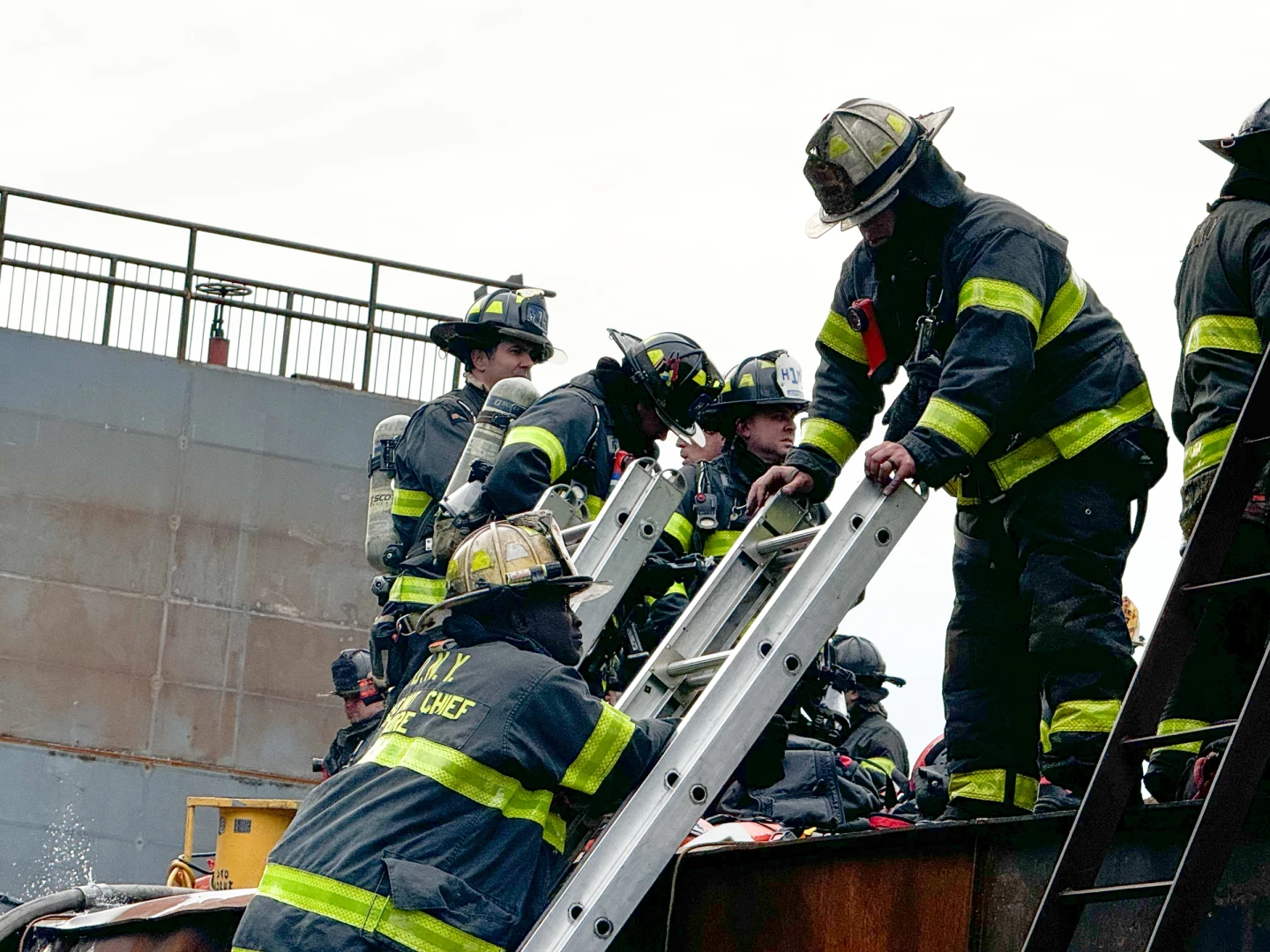
As investigators comb through the Mariners Harbor shipyard site on Staten Island, quantum computing researchers are racing to unlock the secrets of the Friday afternoon fire and explosion that claimed one life and injured over 30 firefighters. While the cause remains under investigation, scientists at the Institute for Advanced Computational Analysis are deploying quantum algorithms to model the incident's complex variables—a process that could accelerate findings by days or weeks.
The disaster unfolded when crews responded to flames trapping two workers in a basement. Within an hour, a massive explosion rocked the 150-foot by 150-foot metal structure. City Fire Commissioner Lillian Bonsignore noted the severity: 'We got very lucky this day. We got lucky in the sense that none of our people were killed. It’s unfortunate we had one fatality, and they did everything they could to get to that person.' Fire marshal Christopher Cuccaro suffered a fractured skull and brain bleed, while 29 firefighters sustained moderate injuries.
Traditional incident analysis typically requires weeks to model the intricate interplay of heat, pressure, and material interactions during such events. But quantum computing changes the game. 'Quantum algorithms process multidimensional data in parallel—simulating thousands of failure scenarios simultaneously,' explains Dr. Elena Rodriguez, a quantum physicist at MIT's Computational Safety Lab. 'In this case, we're analyzing sensor readings, structural integrity data, and historical incident patterns to pinpoint the exact sequence of events that triggered the blast.'
The technology's speed is critical for industrial safety. By running 10^12 simulations in minutes—compared to days with classical computing—researchers can identify hidden vulnerabilities in industrial facilities. 'This isn't just about understanding what happened here,' Rodriguez continues. 'We're creating a predictive framework to flag risks before they become disasters.'
The fire department's chief medical officer, Dr. David Prezant, highlighted the fortunate lack of penetrating injuries: 'Thankfully both of these firefighters do not have penetrating injuries and do not have blast injury damage to their organs, to their heart, lungs or abdomen.' Such data, when processed through quantum models, can refine trauma protocols for future incidents.
As the investigation continues, this approach represents a paradigm shift in industrial safety. 'Quantum computing transforms emergency response from reactive to prophylactic,' says Rodriguez. 'By modeling how materials behave under extreme conditions at molecular levels, we can design safer infrastructure and predict failure points long before they occur. The lessons from this tragedy could save hundreds of lives annually.'
With industries increasingly adopting quantum analysis for infrastructure monitoring, this incident underscores a new era where computational power may prevent the next catastrophe before it happens.}
The disaster unfolded when crews responded to flames trapping two workers in a basement. Within an hour, a massive explosion rocked the 150-foot by 150-foot metal structure. City Fire Commissioner Lillian Bonsignore noted the severity: 'We got very lucky this day. We got lucky in the sense that none of our people were killed. It’s unfortunate we had one fatality, and they did everything they could to get to that person.' Fire marshal Christopher Cuccaro suffered a fractured skull and brain bleed, while 29 firefighters sustained moderate injuries.
Traditional incident analysis typically requires weeks to model the intricate interplay of heat, pressure, and material interactions during such events. But quantum computing changes the game. 'Quantum algorithms process multidimensional data in parallel—simulating thousands of failure scenarios simultaneously,' explains Dr. Elena Rodriguez, a quantum physicist at MIT's Computational Safety Lab. 'In this case, we're analyzing sensor readings, structural integrity data, and historical incident patterns to pinpoint the exact sequence of events that triggered the blast.'
The technology's speed is critical for industrial safety. By running 10^12 simulations in minutes—compared to days with classical computing—researchers can identify hidden vulnerabilities in industrial facilities. 'This isn't just about understanding what happened here,' Rodriguez continues. 'We're creating a predictive framework to flag risks before they become disasters.'
The fire department's chief medical officer, Dr. David Prezant, highlighted the fortunate lack of penetrating injuries: 'Thankfully both of these firefighters do not have penetrating injuries and do not have blast injury damage to their organs, to their heart, lungs or abdomen.' Such data, when processed through quantum models, can refine trauma protocols for future incidents.
As the investigation continues, this approach represents a paradigm shift in industrial safety. 'Quantum computing transforms emergency response from reactive to prophylactic,' says Rodriguez. 'By modeling how materials behave under extreme conditions at molecular levels, we can design safer infrastructure and predict failure points long before they occur. The lessons from this tragedy could save hundreds of lives annually.'
With industries increasingly adopting quantum analysis for infrastructure monitoring, this incident underscores a new era where computational power may prevent the next catastrophe before it happens.}