In brief
Chinese Nobel laureate and physicist Chen Ning Yang has died at 103. Notably awarded the Nobel Prize in Physics in 1957 for significant contributions to the understanding of elementary particles and parity laws, Yang’s influential career spanned over seven decades. His legacy remains in the realms of statistical mechanics and symmetry principles.
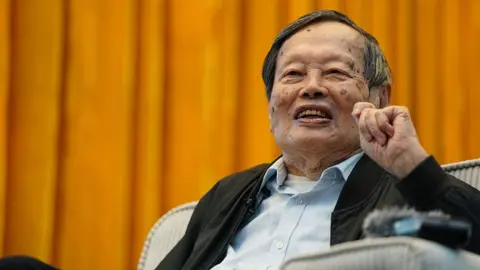
Chen Ning Yang, Nobel laureate and one of the world's most influential physicists, has died at the age of 103, according to Chinese state media. An obituary released by CCTV cited illness as the cause of death.
Yang and fellow theoretical physicist, Lee Tsung-Dao, were jointly awarded the Nobel Prize in Physics in 1957 for their work in parity laws, which led to important discoveries regarding elementary particles—the building blocks of matter. Yang was also a professor at Beijing's prestigious Tsinghua University and an honorary dean of the Institute for Advanced Study at the institution.
Born in 1922 in China's eastern Anhui province, he was the oldest of five children and raised on the campus of Tsinghua University where his father was a professor of mathematics. As a teenager, Yang told his parents: One day, I want to win the Nobel Prize. He achieved that dream at the age of 35, when his work with Lee studying the law of parity earned them the honour in 1957.
The Nobel committee praised their penetrating investigation... which has led to important discoveries regarding the elementary particles. Yang received his science degree in 1942 from National Southwest Associated University in Kunming, and later completed a master's degree at Tsinghua University.
At the end of the Sino-Japanese War, he travelled to the US on a fellowship from Tsinghua and studied at the University of Chicago, where he worked under Italian physicist Enrico Fermi, inventor of the world's first nuclear reactor.
Throughout a prolific career, he worked across all areas of physics, but maintained particular interest in the fields of statistical mechanics and symmetry principles. Yang received the Albert Einstein Commemorative Award in 1957 and was also awarded an honorary doctorate by Princeton University in 1958.
Yang married his first wife Chih Li Tu in 1950, with whom he had three children. After Tu's death in 2003, Yang married his second wife Weng Fan, who is more than 50 years his junior. The pair first met in 1995 when Weng was a student in a physics seminar, and later reconnected in 2004. At the time, Yang called her his final blessing from God.\