Tributes have been pouring in for veteran BBC journalist Sir Mark Tully who has been cremated in the Indian capital, Delhi, a day after he died at the age of 90. Hundreds of people - including friends and family - gathered at the Lodhi crematorium to bid their final goodbye to the broadcaster.
Sir Mark was widely regarded as the BBC's 'voice of India' and was one of the most admired foreign correspondents of his generation. India's Prime Minister Narendra Modi described Sir Mark as 'a towering voice of journalism', adding that 'his connect with India and the people of our nation was reflected in his works'.
On Monday afternoon, mourners lined up around Sir Mark's body at the crematorium. Wrapped in a white cloth, his body was laid on a platform on a bed of flowers, made up of rose petals and tuberoses. Marigold garlands and a wreath were placed on top. Christian priests recited prayers and hymns were sung, before the body was taken for cremation.
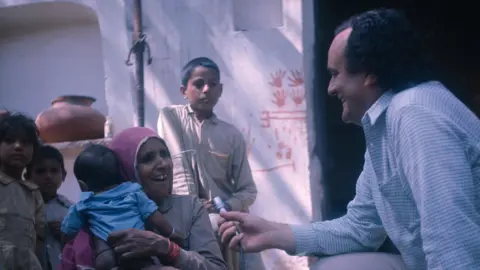
Sir Mark, who died on Sunday at a Delhi hospital where he was undergoing treatment, has been described as a 'chronicler of modern India'. Over a career spanning several decades, he reported on big historical moments that defined South Asia's trajectory, including the Indian army's storming of the Sikh Golden Temple, the birth of Bangladesh, periods of military rule in Pakistan, the Tamil Tigers' rebellion in Sri Lanka and the Soviet invasion of Afghanistan.
In 1992, while reporting on the demolition of the Babri mosque by Hindu hardliners, he faced threats from a mob and was locked in a room for several hours before a local official and a Hindu priest came to his aid. Journalist Satish Jacob, who worked closely with Sir Mark at the BBC for nearly two decades and later co-authored a book with him, shared personal memories that highlight Mark's warm personality.
'As familiar to ordinary villagers as Kashmiri militants and Afghan mujahideen, he was so well known to senior ministers in Delhi that the guards of one simply allowed him to amble through the front door', the Times wrote in its obituary.
Born in Calcutta in British India in 1935, Sir Mark spent much of his life in the country. He was knighted for services to broadcasting and journalism in the 2002 New Year Honours list and also received two of India's highest civilian awards - the Padma Shri and the Padma Bhushan - an uncommon distinction for a foreign national. His legacy continues to inspire many in journalism.
Sir Mark was widely regarded as the BBC's 'voice of India' and was one of the most admired foreign correspondents of his generation. India's Prime Minister Narendra Modi described Sir Mark as 'a towering voice of journalism', adding that 'his connect with India and the people of our nation was reflected in his works'.
On Monday afternoon, mourners lined up around Sir Mark's body at the crematorium. Wrapped in a white cloth, his body was laid on a platform on a bed of flowers, made up of rose petals and tuberoses. Marigold garlands and a wreath were placed on top. Christian priests recited prayers and hymns were sung, before the body was taken for cremation.
Sir Mark, who died on Sunday at a Delhi hospital where he was undergoing treatment, has been described as a 'chronicler of modern India'. Over a career spanning several decades, he reported on big historical moments that defined South Asia's trajectory, including the Indian army's storming of the Sikh Golden Temple, the birth of Bangladesh, periods of military rule in Pakistan, the Tamil Tigers' rebellion in Sri Lanka and the Soviet invasion of Afghanistan.
In 1992, while reporting on the demolition of the Babri mosque by Hindu hardliners, he faced threats from a mob and was locked in a room for several hours before a local official and a Hindu priest came to his aid. Journalist Satish Jacob, who worked closely with Sir Mark at the BBC for nearly two decades and later co-authored a book with him, shared personal memories that highlight Mark's warm personality.
'As familiar to ordinary villagers as Kashmiri militants and Afghan mujahideen, he was so well known to senior ministers in Delhi that the guards of one simply allowed him to amble through the front door', the Times wrote in its obituary.
Born in Calcutta in British India in 1935, Sir Mark spent much of his life in the country. He was knighted for services to broadcasting and journalism in the 2002 New Year Honours list and also received two of India's highest civilian awards - the Padma Shri and the Padma Bhushan - an uncommon distinction for a foreign national. His legacy continues to inspire many in journalism.