Residents in Thailand's Ban Thanon Khot are accustomed to the rumbling of trains – rail is a key mode of transportation connecting the remote town with major cities. But on Wednesday, the mundane rhythm ended in tragedy.
The noise was abnormally loud. A huge, crashing sound, said school volunteer Pitchaya Promenade. I saw a blue crane sliding. It seemed stuck for a moment, and suddenly it flipped over.
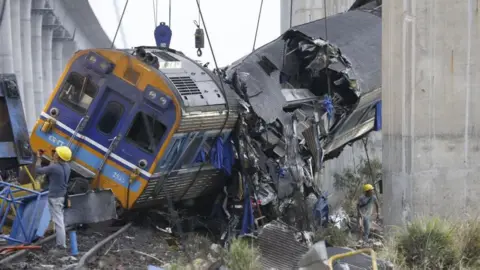
The construction crane had collapsed onto a moving train, killing at least 32 people and injuring 66 others. Most were students and workers traveling for education and employment. Thailand's Public Health Ministry reported that three individuals remain missing.
Rescuers were still extracting bodies from the mangled train when reporters arrived at the site in the evening. Parts of the train had been completely crushed. If I had to describe the damage visually, it looked like a spoon scooping into a slice of cake, said Pitchaya, a trained first aid responder who assisted some of the injured.
One train carriage erupted in flames following the collision, complicating rescue operations as emergency responders used cranes and hydraulic tools to free passengers trapped within the wreckage. Nearby witnesses, including local restaurant owner Penporn Pumjantuek, expressed horror at the scene, with an oil spill contributing to rising smoke and cries for help.
This shocking event has raised numerous questions about safety standards and the reliability of construction practices in Thailand. The crane that collapsed was working on a US$5.4 billion China-backed project, aimed to improve railway links between Bangkok and southwestern China through Laos.
Authorities, including Thai Prime Minister Anutin Charnvirakul, have initiated an investigation into the incident. Concurrently, the State Railway of Thailand is taking legal action against the Italian-Thai Development Company, responsible for the operations where the accident occurred.
The incident has reignited a discussion on construction safety in Thailand, with prior tragedies drawing attention to the need for stricter enforcement of safety regulations. As families mourn their losses, the community calls for accountability and improvements to prevent similar incidents in the future.