
In brief
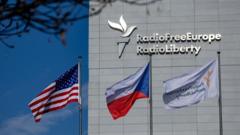
The Czech Republic is urgently seeking support from the European Union (EU) to help maintain the operations of Radio Free Europe/Radio Liberty (RFE/RL) after the Trump administration implemented severe cuts to the broadcaster's funding. Czech Foreign Minister Jan Lipavsky emphasized the vital role of RFE/RL, which is headquartered in Prague, stating that it is "one of the few credible sources" of information in nations under authoritarian regimes, such as Iran, Belarus, and Afghanistan.
RFE/RL has historically played a crucial part in disseminating democratic ideals to millions of listeners in Eastern Europe, especially during the Cold War when communist regimes tightly controlled information. In a recent statement, RFE/RL's president and CEO Stephen Capus warned that terminating the broadcaster's grant would decisively benefit adversarial nations, noting that "the Iranian Ayatollahs, Chinese communist leaders, and autocrats in Moscow and Minsk would celebrate" the collapse of the broadcaster after 75 years of operation.The Committee to Protect Journalists (CPJ) expressed similar concerns, highlighting that numerous journalists would be impacted by the funding cuts, leaving those in censored countries at heightened risk. RFE/RL claims to engage a weekly audience of nearly 50 million people across 23 countries, including places like Russia, Ukraine, and other former Soviet territories.In light of these developments, Minister Lipavsky intends to coordinate with EU foreign ministers to explore strategies to "at least partially maintain" RFE/RL's broadcasting capabilities. The funding reduction aligns with President Trump's notable departure from conventional media policy, contrasting sharply with the heavy investments made by Russia, China, and Iran in their state-owned media to counter Western influences. Recent reports reveal that most of Voice of America's full-time staff have been put on administrative leave, while many contractors responsible for non-English language broadcasts have been laid off, prompting a crisis within the agency.These changes signify a tumultuous shift in the landscape of global information dissemination during a time when democratic values are increasingly challenged worldwide.



