In brief
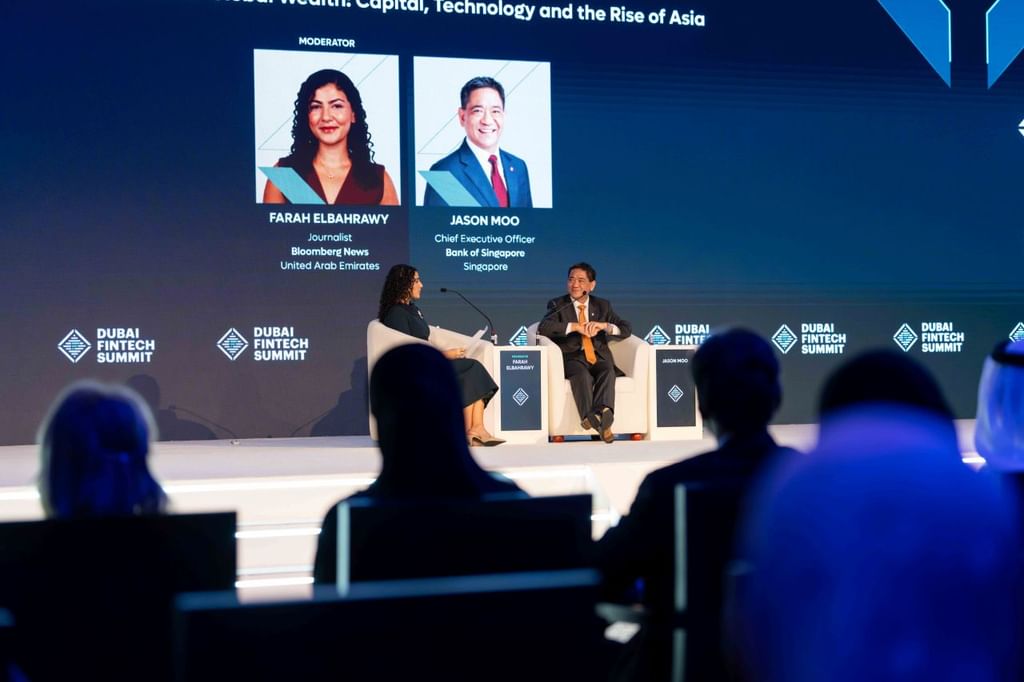
During a Dubai FinTech Summit fireside chat, Bank of Singapore CEO Jason Moo underscored how Dubai and Singapore jointly serve as key wealth hubs, emphasizing rising investment ties between Asia and the Middle East and the transformative impact of artificial intelligence in private banking. He noted increased interest from Chinese clients in Dubai and ASEAN markets, and outlined the bank’s strategy to support cross‑border wealth management through its DIFC branch and OCBC Group network.
At the opening day of the Dubai FinTech Summit on 5 November 2026, Bank of Singapore chief executive Jason Moo delivered a fireside chat that positioned the city and its sister hub in Singapore as complementary anchors for global wealth management.
Moo addressed the theme “A New Era for Global Wealth: Capital, Technology and the Rise of Asia,” stressing that Asia supplies both capital and avenues for investment, while more international clients are now seeking opportunities there. He highlighted a steady rise in international clientele over the past five years, although Asian families still dominate the bank’s customer base.
Artificial Intelligence and Private Banking
In the era of data‑driven finance, Moo referred to artificial intelligence, or AI—computer systems that learn from data to automate decision making—as a catalyst reshaping private banking. The CEO suggested that the integration of AI enables finer risk assessment, hyper‑personnalised portfolio strategies, and streamlined client service chains.
“There is no cannibalization. There’s enough wealth around the world to really be managed in different locations,” Moo said, underscoring a belief that geographic diversification can coexist with growth in both hubs without displacing one another.
There is no cannibalization. There’s enough wealth around the world to really be managed in different locations.
He elaborated that Dubai’s strategic position between Asia and Europe, supported by the technology and investment ecosystems around the Dubai International Financial Centre (DIFC), makes it an attractive custodian for funds flowing from the Gulf Cooperation Council and the Indian subcontinent.
Bank of Singapore identifies the DIFC as one of its three strategic hubs, alongside Hong Kong and Singapore itself. The DIFC branch has increased its staffing to accommodate a growing stream of Middle Eastern clients looking for custody and investment opportunities in Asian markets, especially the Association of Southeast Asian Nations (ASEAN).
Moo also pointed to a noticeable uptick in interest from Chinese conglomerates and high‑net‑worth individuals. The bank has orchestrated visits to Dubai for Chinese investors and engaged senior financial executives from China, while its DIFC team delivers dedicated Chinese coverage to support this expanding segment.
Family offices, traditionally focused on wealth preservation, are now adopting institutional approaches to allocation and diversification. Moo described a shift toward more robust risk‑return frameworks and larger scale exposure to alternative asset classes, spurred by the reach of AI‑enhanced analytics.
The bank’s strategy is backed by OCBC Group’s extensive network across Greater China and ASEAN, allowing it to support clients navigating the Asia‑Middle East corridor. Moo said that the next wave of alliances will likely target this corridor, creating tighter integration between asset management platforms and cross‑border regulatory environments.
He concluded that both Dubai and Singapore have room to grow over the coming decade, citing the lack of mutually exclusive markets and the global pool of wealth that can be managed in multiple jurisdictions. As the global capital flow continues to densify, the two cities’ complementary strengths—Dubai’s geo‑strategic logistics and Singapore’s regulatory robustness—will sustain their roles as leading wealth hubs.