In brief
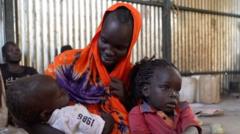
Caught in the crossfire of Sudan's devastating civil war, Sarah Williams—a mother of five originally from South Sudan—navigates perilous circumstances in Renk as both nations face escalating violence and humanitarian crises.
In the heart of a devastating conflict, Sarah Williams stands as a symbol of resilience amidst chaos. As war engulfed her neighborhood in Khartoum, Sudan's capital, she cradled her one-year-old son and huddled with her children, dodging bullets as their home shattered around them. "It was chaos," the 33-year-old mother recalls. Originally hailing from South Sudan, Sarah's journey has been fraught with upheaval since the 2013 outbreak of civil war shortly after her nation gained independence. She fled South Sudan after a vicious power struggle erupted between President Salva Kiir and his former deputy Riek Machar, claiming 400,000 lives and displacing millions. Seeking refuge in Khartoum, Sarah found a fragile semblance of stability, working as a housekeeper for a local family. However, the tranquility was short-lived as fighting erupted in 2023 between military factions led by Abdel Fattah al-Burhan and Mohamed Hamdan Dagalo, known as Hemedti. "The conflict began among the leaders but quickly engulfed innocent South Sudanese," Sarah explains, reflecting on her harrowing personal experiences. Since the onset of violence, 150,000 lives have been lost, with an alarming 12 million people displaced, turning Khartoum into a war-torn ghost town. After her home suffered devastating attacks, Sarah and her children returned to South Sudan, only to find their own country embroiled once more in conflict, casting doubt over the fragile 2018 peace agreement between Kiir and Machar. Now residing in Renk, a once-quiet border town transformed into a transit hub, Sarah dreams of returning to her hometown of Nasir. Yet, the journey is perilous; Nasir has become a battlefield, leaving her family unreachable and her hopes dimmed. "I don’t know if they are alive," she admits quietly, her uncertainty evident in her weary eyes.With over 9,000 people crammed into the Renk Transit Centre—three times its capacity—disease and hunger fester. Refugees rely on minimal cash aid, lasting just weeks, forcing them into desperate measures like chopping trees for firewood. "The forest is empty now," she laments, illustrating how war devastates both lives and environments. Overcrowded shelters exacerbate fundamental health crises and prolonged waiting times for medical assistance highlight the dire conditions.As the ongoing conflict exacerbates humanitarian needs, agencies scramble to relocate families to safer regions of South Sudan. Yet, the situation remains precarious as rising malaria cases coincide with a cholera epidemic already claiming lives. Health resources are stretched to breaking point, reflected by a local clinic's struggle to manage patient loads amidst a staff shortage. Caught between two conflicts, the plight of Sarah Williams and her fellow refugees exemplifies the escalating humanitarian crisis. Tensions in South Sudan have surged with the fallout from Kiir and Machar's political rivalries and external military interventions. The fragility of peace remains precarious, leaving millions in uncertainty as conflicts continue unabated in both Sudan and South Sudan. Sarah Williams finds hope in her desire to rebuild her life in her homeland, despite the harsh reality of her circumstances.