
In brief
President Trump has signed an executive order aimed at dismantling the Department of Education, arguing that current spending yields poor results. While the move aligns with conservative aspirations, it faces obstacles in Congress and substantial legal challenges. Critics warn that this could severely impact public education funding and programs.
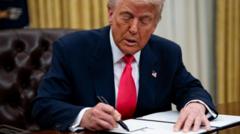
US President Donald Trump has taken a significant step towards dismantling the Department of Education by signing an executive order that reflects a long-standing aspiration among some conservatives. At an event in Washington DC, Trump reiterated his commitment to shuttering the department, arguing that it is ineffective and overly costly. "We're going to shut it down as quickly as possible," he stated.Despite Trump's certainty, implementing such drastic measures requires congressional approval, which is unlikely given the current political landscape. Legal challenges loom on the horizon, with many opponents rallying to block the administration's initiative as well as the considerable layoffs planned for agency employees.Highlighting the discrepancies in US educational performance, Trump claimed that despite significant spending, American students rank poorly in global achievement metrics. The White House has indicated that it will aim to trim the department while remaining within legal limits. Yet, similar initiatives by the Trump administration have previously encountered resistance and may do so again.At the signing ceremony, Trump praised Linda McMahon, his appointee as Secretary of Education, suggesting that she would be the last person to hold that position if the agency is dissolved. Nonetheless, any efforts to formally close the department would be challenging, requiring a bipartisan consensus unlikely to be reached with the current slim Republican majority in the Senate.Even in the absence of a total closure, the administration could severely reduce funding for the education department, echoing actions taken against the US Agency for International Development (USAID). The executive order lacks specific details regarding which programs may be eliminated but directs McMahon to facilitate the transition of educational authority to state and local governments.Established in 1979, the Department of Education manages federal funding, student loans, and support programs aimed at assisting low-income students. Trump has further accused the agency of promoting what he describes as a "woke" agenda that he claims indoctrinates young people on various socio-political issues.After her appointment, McMahon briefed department staff on their final mission, calling it an opportunity to enhance American education and strengthen its future. Trump's plans have faced backlash from prominent education advocates, including America’s largest teachers' union, which cautioned that the proposed "war on woke" could ultimately undermine support for vulnerable student populations.Critics emphasize that most funding for public education in the U.S. derives from state and local sources, with federal contributions accounting for a mere 13% of total funding. Furthermore, any potential restructuring would not alter that majority of control over school curricula, which is set by local and state authorities.Having previously attempted to diminish the Department of Education’s influence, former President Ronald Reagan initiated similar calls for reduction shortly after it was established. Now, the agency, being the smallest in the cabinet, may be subjected to significant cuts as part of Trump's broader efforts led by the Department of Government Efficiency (Doge), overseen by prominent tech figure Elon Musk.With substantial layoffs anticipated, nearly 2,100 individuals are expected to be placed on administrative leave, illustrating the deep impact of Trump's order on the workforce within the education sector.


