In brief
At ADIPEC 2026, students from Zayed University demonstrated a promising method for converting desert biomass into functional polymers. Their work, supervised by Dr. Maisa El Gamal, showed successful cellulose extraction and chemical modification confirmed by infrared spectroscopy and thermal analysis. The project highlights potential applications in agriculture, soil water management, and oil‑and‑gas drilling fluids, supporting UAE’s circular‐economy goals.
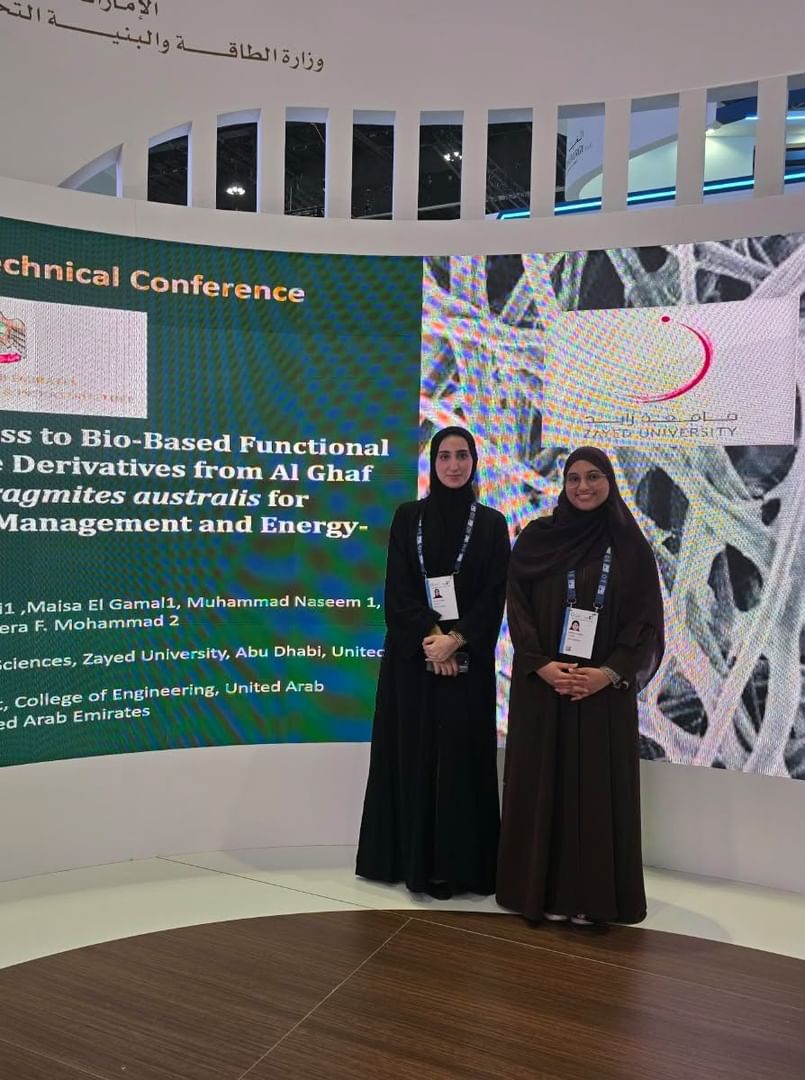
On 6 November 2026, students from Zayed University presented a paper at the ADIPEC 2026 Technical Conference that could transform how the region manages water and energy resources. The project, titled From desert biomass to bio‑based functional polymers for sustainable water management and energy‑sector applications, explored ways to turn locally available plant residues into sustainably produced, value‑added materials.
The research team—Sawsan Salem Mubarak Mohamed Aljaberi, Shahad Omar Salem Omar Aljaari, and supervising Dr. Maisa El Gamal—belongs to the Department of Environmental Science and Sustainability, College of Natural and Health Sciences at Zayed University. The Ministry of Energy and Infrastructure invited the group to showcase their work at this international energy event. The project centers on extracting cellulose, a natural polysaccharide found in plant cell walls, and converting it into polymers that can be used in various industrial contexts.
Cellulose is the most abundant organic polymer on Earth and can be described as a long chain of glucose molecules linked together. By removing impurities and breaking the polymer into shorter chains, researchers can chemically modify it to create materials with tailored properties. In this study, the students performed a controlled hydrolysis to isolate cellulose from desert plant residues and then introduced functional groups through a reaction that increased the material’s affinity for water and its mechanical strength.
The validity of the chemical transformations was confirmed by Fourier‑transform infrared spectroscopy, a technique that identifies molecular bonds by measuring the absorption of infrared light. The resulting spectra displayed clear peaks corresponding to the functional groups intended, indicating successful conversion from cellulose to the target biopolymers. Thermogravimetric analysis, another analytical method that measures changes in weight as a sample is heated, provided insight into the thermal stability of the newly synthesized materials. The curves showed that the polymers maintained structural integrity up to temperatures relevant for typical industrial processes.
These analytical fingerprints demonstrate that the research is on track to produce robust, bio‑based polymers that perform under conditions encountered in water management and oil‑and‑gas extraction. The preliminary data suggest that the polymers can retain moisture, thus improving soil water storage and potentially benefiting agricultural productivity in arid regions. In oil‑and‑gas fields, the materials could be incorporated into drilling fluids to reduce friction and improve sweep efficiency, thereby lowering energy consumption.
Methodology
The study began with the collection of plant residues native to the UAE, such as dried leaves and stems from salt‑tolerant species. The raw biomass was washed, dried, and ground before an acid hydrolysis step that released cellulose fibers. After neutralization and filtration, the cellulose was purified and dissolved in an aqueous solution at elevated temperature. Chemical reagents were then added to introduce carboxyl and amino groups, yielding a polymer with increased hydrophilicity and potential for cross‑linking. The modified material was cast into films and dried for further testing.
Fourier‑transform infrared spectra were collected using a standard ATR‑FTIR instrument, where the sample face contacts a diamond crystal. The data were compared against reference spectra for unmodified cellulose to identify new absorption bands. Meanwhile, thermogravimetric analysis was performed on a slice of the polymer heated from 25 °C to 600 °C under a nitrogen flow; the weight loss profile displayed a single major step, indicating controlled degradation and suitability for high‑temperature applications.
Implications
By showing a viable pathway to transform desert waste into functional polymers, the team has highlighted a component of the UAE’s circular‑economy strategy. The circular economy aims to keep resources in use for as long as possible, so the conversion of crop residues—often discarded—into high‑value materials aligns with national sustainability goals.
The potential uses of these polymers extend beyond agriculture and industrial fluids. With their improved water‑holding capacity, the materials could be incorporated into seed coatings or soil amendments to enhance drought resilience. In the energy sector, their resistance to high temperatures and ability to reduce drag in drilling muds could decrease operational costs and lower the environmental footprint of exploration activities.
Presented in front of an audience of energy engineers, policymakers, and industry leaders, the students’ findings underscore the importance of interdisciplinary research. The project combined environmental science, chemistry, and engineering principles to address a practical problem in the desert region. The invitation from the Ministry of Energy and Infrastructure further emphasizes the strategic relevance of such research to national priorities.
As the UAE continues to diversify its economy and invest in green technologies, the innovative work of Zayed University students demonstrates how local scientific talent can contribute to global challenges. Their project offers a blueprint for turning otherwise wasted biomass into materials that can improve resource efficiency, support agricultural resilience, and lower the environmental impact of energy extraction.