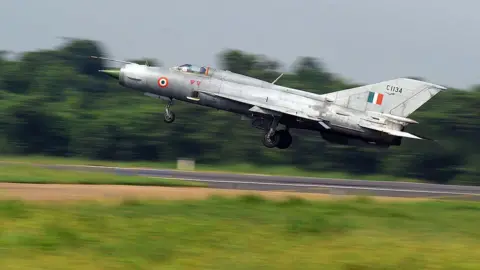
The first time he throttled the MiG‑21 to full power, soaring 20km above the Earth at twice the speed of sound, the young fighter pilot felt utterly weightless, as if the sky itself had let him go.
At Mach 2 you can feel the lightness in the stomach. The MiG‑21's turns at that speed are vast - banking sharply can carry you over many kilometres before completing a full arc, recalls Air Marshal (retired) Prithvi Singh Brar. He joined the Air Force in 1960, switched to the Soviet jet in 1966, and flew it for 26 years.
I loved flying the MiG-21 the way a bird loves the sky. In combat it protected me - when the hawk comes for the bird, the clever bird gets away. That's what the MiG-21 was for me, he said.
After six decades of admiration - and later, infamy - India's most iconic warplane is finally taking its last flight. At its peak, the MiG‑21 constituted two-thirds of the Indian Air Force (IAF) fleet. It inspired fierce loyalty among its pilots yet earned the grim nickname flying coffin due to a series of deadly crashes in its later years.
Official figures indicate that from 1966 to 1980, India procured 872 MiG aircraft of various models. Between 1971 and 2012, 482 MiG crashes resulted in the loss of 171 pilots, 39 civilians, and eight service personnel, attributed to both human error and technical faults.
The MiG-21 has a chequered legacy. The fighter was the mainstay of the IAF for over three decades and served in various roles in all of India's conflicts since the 1965 Pakistan war, says Rahul Bhatia, an analyst. Yet, the MiG became better known for its high crash rate starting in the early 2000s.
Designed by the Soviets and first introduced in 1963, the needle-nosed MiG-21 was versatile, operational with over 50 air forces globally, making it one of the most widely used supersonic jets in history.
In India, the MiG-21 became the cornerstone of IAF squadrons. Despite its design limitations, pilots pushed the aircraft beyond its known capabilities in close combat situations. We adapted the aircraft to Indian conditions in a remarkable way, reflects Air Marshal Brar.
Those who flew it expressed a mixture of nostalgia and frustration. Even as engine issues and high landing speeds contributed to numerous accidents, the bond formed between pilots and the MiG was profound. It was never just a machine - it was a partner in the sky, Air Marshal Brar concluded.