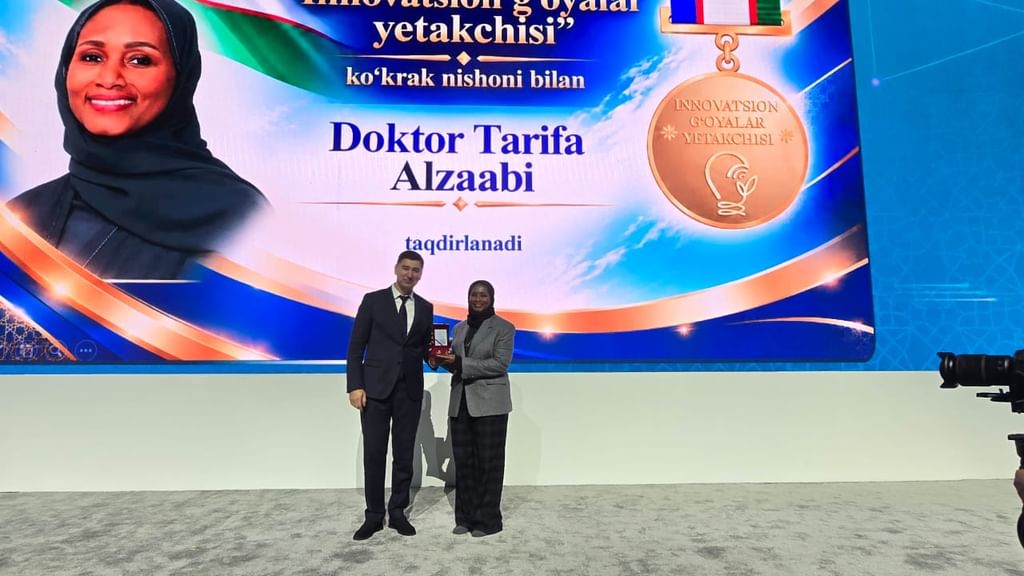
On 7 November 2026, the International Centre for Biosaline Agriculture (ICBA) celebrated the scientific impact of its Director‑General, Dr. Tarifa Alzaabi, when he received the “Leader of Innovative Ideas” honorary badge at InnoWeek 2026 in Tashkent, Uzbekistan. The accolade, bestowed by the Agency for Innovative Development and the Central Council of the Youth Union, acknowledges the centre’s success in translating biosaline agricultural research—agriculture practices that allow crops to grow in saline and arid environments—into market‑ready solutions that directly benefit Uzbek farmers, particularly women and young entrepreneurs.
ICBA’s flagship Farmers’ and Agro‑Entrepreneurs Accelerator, implemented with support from the Abu Dhabi Fund for Development (ADFD) and the Agency for Innovative Development under the Ministry of Higher Education, Science and Innovation, is a cornerstone of this effort. The accelerator combines research expertise, development finance and local knowledge to help participants transform climate‑resilient crops into products that meet local and regional market needs. It is part of a broader ADFD‑funded project titled “Development of Sustainable Agricultural Production Systems in Degraded Areas of Karakalpakstan.”
When Dr. Alzaabi accepted the badge, he reflected on the collaborative nature of the work.
"I am proud to receive this recognition and deeply appreciate the efforts of the ICBA team and our partners in Uzbekistan, as well as the support of ADFD in connecting scientific solutions with local development priorities,"
"I am proud to receive this recognition and deeply appreciate the efforts of the ICBA team and our partners in Uzbekistan, as well as the support of ADFD in connecting scientific solutions with local development priorities."Whether in a laboratory or a field plot, ICBA has prided itself on engaging with local stakeholders to adapt agro‑technologies to harsh conditions.
In a second statement, Dr. Alzaabi highlighted the broader societal benefits of the accelerator programme.
"The accelerator programme brings together development finance, research expertise and local knowledge. Participants are transforming crops into products that meet market needs, expanding income opportunities and strengthening the participation of women and young people in the agricultural economy,"
"The accelerator programme brings together development finance, research expertise and local knowledge. Participants are transforming crops into products that meet market needs, expanding income opportunities and strengthening the participation of women and young people in the agricultural economy."He also noted that the recognition reflects the role of Emirati women in leading research institutions and advancing international scientific cooperation.
Collaborative Foundations and Policy Support
The badge was established by a resolution of the Cabinet of Ministers of the Republic of Uzbekistan, signalling national commitment to innovative agricultural practices. ICBA’s partnerships extend beyond the agricultural sector, drawing on financial support from the Abu Dhabi Fund for Development and strategic guidance from the Agency for Innovative Development. This multi‑layered approach aligns research outcomes with policy objectives, ensuring that scientific advances translate into tangible livelihoods.
At InnoWeek 2026, the event organizers emphasized the importance of linking research with local development priorities. The recognition of ICBA’s work underscores a growing trend in the region: harnessing targeted research to address specific environmental challenges such as saline soils and water scarcity. By capacitating local farmers and entrepreneurs, the accelerator model demonstrates a scalable pathway for other developing regions facing similar constraints.
Looking forward, ICBA plans to expand the accelerator framework to additional degraded landscapes across Central Asia. The centre aims to refine crop varieties that can thrive under high salinity, lower water inputs, and limited nutrient availability—conditions that increasingly define global food security scenarios. By building on the momentum from InnoWeek 2026, Dr. Alzaabi and his team are poised to continue bridging the gap between biosaline research and market‑driven agricultural innovation.