In brief
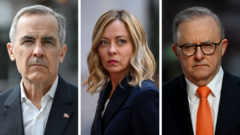
World leaders, including Italy's Giorgia Meloni and Australia's Anthony Albanese, voice strong disapproval of President Trump's new tariffs on EU imports, which could escalate into a trade conflict affecting global economies.
Italian Prime Minister Giorgia Meloni has condemned U.S. tariffs targeting European Union imports, labeling them as "wrong" after President Donald Trump announced a sweeping 20% levy on EU goods. Meloni’s comments are part of a broader international response to what Trump characterized as "liberation day," introducing a universal 10% baseline tariff on all imports into the U.S. effective April 5. Over 60 countries, including those within the EU, face intensified tariffs starting April 9. Certain smaller nations like Lesotho will be particularly hard-hit, facing a staggering 50% tariff. Trump claimed these measures would "make America rich again," insisting he has been "very kind" in his tariff decisions.Despite being considered a Trump ally, Meloni cautioned that the EU tariffs would ultimately harm both the EU and the U.S. She pledged to negotiate a resolution with the U.S. to avert a trade war. Spain's Prime Minister Pedro Sánchez echoed Meloni's concerns, emphasizing Spain's commitment to protect its businesses while advocating for an open international market. Meanwhile, Ireland's Trade Minister Simon Harris expressed readiness to engage with the U.S., labeling negotiations as the "best course" forward. Taoiseach Micheál Martin referred to Trump’s announcement as "deeply regrettable," suggesting it would favor no one.From outside the EU, Australian Prime Minister Anthony Albanese noted that American consumers would bear the brunt of what he termed "unjustified tariffs," while his government refrained from implementing reciprocal tariffs, stating, "We will not join a race to the bottom that leads to higher prices and slower growth."In response to the tariff imposition, Brazil’s Congress approved the Economic Reciprocity Law aimed at mitigating the impact of Trump's 10% tariffs. While President Luiz Inácio Lula da Silva had not issued a direct response, he indicated last week that Brazil "cannot stand still" in the face of new tariffs.Following Trump’s tariffs announcements, U.S. Treasury Secretary Scott Bessent urged countries to avoid retaliation, warning of potential escalations should they choose that route. Notably, Canada and Mexico, the U.S.’s primary trade partners, were excluded from this recent pronouncement. The White House clarified that bilateral relations would continue under previous executive orders, which imposed a 25% tariff on these nations in the context of addressing fentanyl and border concerns. Nonetheless, Canadian Prime Minister Mark Carney warned that the tariffs would significantly impact millions of Canadians, promising to counteract these measures. He asserted that Trump's tariffs would "fundamentally change the global trading system."