
In brief
Amid escalating anti-corruption protests, Prime Minister KP Sharma Oli has resigned after public outcry over recent police clashes that left multiple protesters dead. Demonstrators set fire to the parliament and other government buildings, showcasing a rapidly deteriorating political landscape fueled by longstanding grievances against corruption and government actions, including a contentious social media ban. The absence of clear leadership post-resignation raises concerns about the country's immediate future.
Prime Minister KP Sharma Oli has resigned amid Nepal's worst unrest in decades, as public anger mounts over the deaths of 19 anti-corruption protesters in clashes with police on Monday.
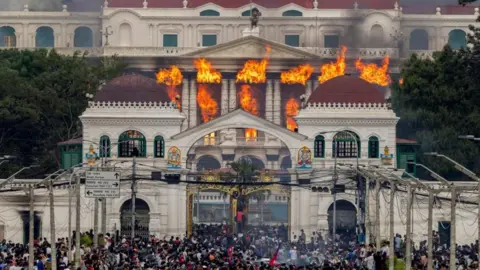
On Tuesday, crowds set fire to parliament in the capital Kathmandu, sending thick black smoke billowing into the sky. Government buildings and the houses of political leaders were attacked around the country.
Three more deaths were reported on Tuesday. Amid the chaos, jail officials said 900 inmates managed to escape from two prisons in Nepal's western districts.
The demonstrations were triggered by a ban on social media platforms. It was lifted on Monday - but by then protests had swelled into a mass movement.
Nepal's army chief issued a statement late on Tuesday accusing demonstrators of taking advantage of the current crisis by damaging, looting and setting fire to public and private property.
It said if unrest continued, all security institutions, including the Nepal Army, are committed to taking control of the situation, effective from 22:00 local time (16:15 GMT; 17:15 BST), without detailing what this might entail.
While the prime minister has stepped down, it's not clear who will replace him - or what happens next, with seemingly no-one in charge. Some leaders, including ministers, have reportedly taken refuge with the security forces.
So far, the protesters have not spelled out their demands apart from rallying under the broader anti-corruption call. The protests appear spontaneous, with no organised leadership.
Inside parliament, there were jubilant scenes as hundreds of protesters danced and chanted slogans around a fire at the entrance to the building, many holding Nepal's flag.
Corruption has been a long-term issue, and many believe it is "high time our nation, our prime minister, and anyone in power changes, because we need to change."
The protests were ignited by a ban on social media imposed last week, which was justified as necessary to tackle fake news and hate speech but criticized as an attack on free speech.
Years of discontent culminated in action after the government lifted the ban, as young protesters expressed their frustration with political elites and the lack of accountability.
Thousands attempted to storm the parliament building, causing chaos and prompting a series of curfews across multiple districts.
With no clear pathway to stability following the resignation, questions loom about the future trajectory of Nepal's political landscape in the wake of such unprecedented turmoil.
