
In brief
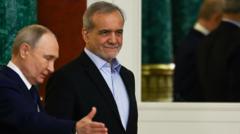
In a significant development, Russia and Iran have formalized their military cooperation by signing a twenty-year strategic partnership treaty, amidst a visit from Iranian President Masoud Pezeshkian to Moscow.
During a special ceremony, the leaders reaffirmed their commitment to collaborate on various fronts, including defence, technology, energy, and trade. The agreement signals a deeper alignment between the two nations, particularly in light of escalating tensions due to Russia’s invasion of Ukraine, which has led Moscow to seek closer ties with allies such as Iran, China, and North Korea.The new treaty includes provisions for regular consultations and cooperative actions in response to military and security challenges. Additionally, it lays the foundation for joint military exercises in their respective territories and beyond while mutually ensuring that neither nation’s territory will be exploited for actions that may threaten the other.President Pezeshkian emphasized the signing of the accord as a pivotal moment in Russian-Iranian relations, indicating a shift towards a more integrated partnership. With Iran currently providing drones and reportedly supplying ballistic missiles to Russia, this collaboration is significant for both nations' military capabilities.Trade relations are also set to benefit from this treaty, particularly in the energy sector where both countries have potential for growth. President Vladimir Putin indicated plans for Russia to assist in building new nuclear power units in Iran, alongside proposals for supplying surplus Russian gas to Tehran—a particularly timely move as European sanctions have reduced Russian gas imports.Moreover, negotiations are underway for a gas pipeline linking Russia and Iran, likely to cross through Azerbaijan, with Putin suggesting that this could enable the supply of up to 55 billion cubic meters of gas annually to Iran. This treaty not only enhances military and energy cooperation but also signifies a strategic pivot for both countries as they navigate a rapidly changing geopolitical landscape.


