In brief
As the Parker Solar Probe ventures into the Sun's outer atmosphere, it aims to unravel solar mysteries and improve our understanding of space weather's effects on Earth.
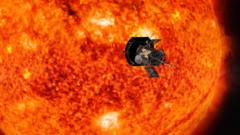
NASA's Parker Solar Probe is on a momentous journey as it attempts to make the closest-ever approach to the Sun. The spacecraft is set to dive into our star's outer atmosphere, facing extreme temperatures and intense radiation, effectively putting its technological resilience to the test. During this daring fly-by, the probe will be out of communication for several days, with scientists anxiously waiting for a signal-expected at 05:00 GMT on December 28-to confirm its survival.Dr. Nicola Fox, NASA's head of science, emphasizes the importance of this mission, noting, "For centuries, people have studied the Sun, but you don't experience the atmosphere of a place until you actually go visit it." This fly-by on Christmas Eve will not only break records but could also yield critical insights into how the Sun functions. The Parker Solar Probe, launched in 2018, has already completed 21 orbits around the Sun, but this latest visit marks a significant milestone. At its closest point, it will be just 3.8 million miles (6.2 million km) from the Sun’s surface. To put this into perspective, while Earth is about 93 million miles away from the Sun, the probe will be around four centimeters away if the distances were scaled to one meter.Facing temperatures reaching 1,400 °C and intense radiation that could potentially threaten onboard electronics, the probe is shielded by an 11.5cm (4.5 inches) thick carbon-composite shield. Its strategy for survival involves quick maneuvers: it will travel at a staggering speed of 430,000 mph, a rate that allows it to swiftly enter and exit the hazardous environment around the Sun.Dr. Jenifer Millard, an astronomer at Fifth Star Labs, articulates the significance of this mission, particularly regarding the mystery of the Sun's corona, which is hotter than its surface despite being further away. The probe's journey will also contribute to our understanding of solar wind—the continuous flow of charged particles from the corona—and its impacts on Earth’s magnetic field, which can lead to beautiful auroras, but also pose risks to electrical infrastructure and communication systems.As scientists anticipate signals from the Parker Solar Probe, the team remains hopeful and confident in its engineering. Dr. Fox expresses a mix of excitement and anxiety, stating, "I will worry about the spacecraft. But we really have designed it to withstand all of these brutal conditions. It's a tough, tough little spacecraft." If the probe successfully endures this bold endeavor, it will continue its exploratory missions around the Sun, potentially unlocking more secrets of our celestial neighbor.