
In brief
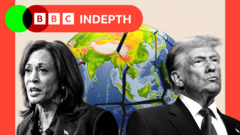
The November 2024 US presidential election presents a pivotal moment for global politics, with candidates Kamala Harris and Donald Trump vastly differing in their international approaches. Analysts suggest that Harris's continuation of current foreign policies may stabilize alliances, while Trump’s isolationism and unpredictability could heighten global tensions, particularly concerning military engagements, trade relations, and climate policy.
In February 2023, US President Joe Biden took a surprising trip to Kyiv, showcasing America’s commitment to supporting Ukraine amid ongoing conflict. As the 2024 presidential elections approach, the world awaits the decision: will Vice President Kamala Harris continue Biden's legacy, or will Donald Trump reemerge as president with his divergent vision of American foreign policy?The potential outcomes raise substantial questions about the US's role on the global stage—a position some observers currently deem tenuous. Various geopolitical crises are challenging the reliability of American influence, as authoritarian regimes reel from regional upheaval and global wars cloud future alliances. Inside NATO, apprehensions loom over Trump potentially returning to office. Rose Gottemoeller, former deputy secretary general of NATO, sounds an alarm about the implications of a Trump presidency. "His past threats to withdraw from NATO resonate heavily," Gottemoeller states. The US contributes significantly to NATO’s military expenditures, accounting for two-thirds of total spending. Although Trump insists he is pressuring allies to increase their military contributions, his unpredictable foreign policy could deter crucial European alliances. Conversely, a Harris victory could cultivate renewed confidence within NATO, allowing for continued partnership and support for Ukraine.However, as long-term conflicts evolve, there’s a growing sentiment among US lawmakers to withdraw from extensive foreign aid commitments, which includes support for Ukraine. Whether Harris or Trump takes the mantle, experts predict that mounting pressure will compel Ukraine to negotiate peace amidst relentless conflicts fueled by competing interests from multiple countries.As power confrontations rise to precarious levels reminiscent of the Cold War, the US remains integral to global peace, but its effectiveness in resolving disputes has undeniably shrunk. Comfort Ero, of the International Crisis Group, asserts that America’s moral authority has diminished. She highlights a dissonance in approaches toward global crises. Under Harris, the historical dedication to Ukrainian support may persist, but skepticism surrounds Trump's leaning towards stronger ties with autocratic leaders and a potential appeasement of Russia.On economic issues, the stark contrast again surfaces. Trump's aggressive tariffs on China signify a confrontational stance on trade, which could prove disruptive in the already fluctuating global economic landscape. In contrast, Harris is likely to pursue a moderated approach aimed at stabilizing US-China relations, yet tensions persist regardless of the eventual victor.Climate change policy will also be significantly impacted by the election's outcome. Trump’s previous dismissal of climate initiatives and potential withdrawal from international climate accords poses dire consequences. Conversely, Harris inherits the challenge of harnessing enthusiasm for sustainable policies while responding to rising environmental crises. Former Irish president Mary Robinson calls for urgent action amidst a reality where climate conditions increasingly threaten global well-being.The humanitarian realm also casts a long shadow over the upcoming election. Martin Griffiths, a veteran humanitarian leader, stresses the high-stakes nature of US leadership, implying that a return to Trump's isolationism would deepen global instability. Critics of both candidates urge for action that empowers the US to act responsibly in crisis zones, particularly in the Middle East.As the world stands on the brink of uncertainty, it remains to be seen how US leadership shapes international relations, military alliances, and the approach to pressing global dilemmas. The echo of both candidates in their commitments could significantly redefine the global landscape in a time of urgent need for principled leadership and humanitarian responsibility.


