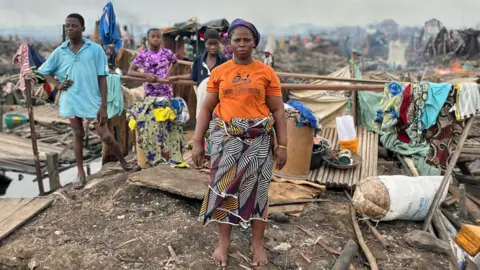
A mother of five, Anna Sobie's wooden home is one of many that has been demolished in a shanty town in a lagoon in Lagos, with critics describing it as a 'land-grab' by the authorities to gentrify the prime waterfront spot in Nigeria's biggest city.
Lagos State government officials deny the allegation, saying they are demolishing parts of Makoko - the country's biggest informal waterfront settlement - because it is expanding near high voltage power lines, posing a major health and safety risk.
Sobie and her children now sleep on the narrow broken platform where their house stood until a few weeks ago on Lagos Lagoon. This is the biggest of 10 lagoons in a mega-city that is facing an acute housing crisis - and where life is becoming increasingly expensive, pushing more people to the margins of society.
As Sobie spoke to the BBC, canoes - steered with paddles or long bamboo poles - moved through the narrow waterways, carrying mattresses and sacks of clothes belonging to the displaced people.
Residents say the demolitions began two days before Christmas, when excavation teams accompanied by armed police moved into sections of the waterfront settlement facing the Atlantic Ocean.
In a joint statement last month, 10 non-governmental organisations said that 'armed thugs, security personnel and demolition teams with bulldozers descended repeatedly on the community' to tear down homes, and burn them.
'Homes were set on fire with little or no notice, in some cases while residents were still [inside],' the NGOs added.
When the BBC visited Makoko, smoke, from the rubble of torched homes or from fires that people had lit, burning damp wood to dry their clothes, was hanging in the air. Excavators worked along the shoreline - houses built on wooden stilts over the lagoon were still being pulled down, their planks collapsing into the water below. Corrugated metal sheets fell from roofs and drifted between boats.
Makoko was founded in the 19th Century by fishing communities who have lived in the settlement ever since, alongside other low-income families and migrants who come to Lagos in search of better opportunities. Ownership of the lagoon is fiercely contested. The state government claims ownership of it under federal law, saying Makoko has been built without planning permission or occupancy rights.
Older residents dispute this, saying the settlement predates modern Lagos, and they have what they call a customary right to it. Estimates of Makoko's population vary, from 80,000 to 200,000, but much of the settlement now lies in fragments.
The NGOs stated that more than 10,000 people have been displaced after the destruction of more than 3,000 homes, schools, clinics, and churches. Sobie's home was among those that have been destroyed.
'I was inside when it started,' she says. 'The noise was very loud. When we came out, we saw the excavator.' There was little time to move her family's belongings; her son Solomon's school in Makoko was demolished the same day.
Sobie and her children were homeless; the situation has forced Solomon to help his mother gather firewood from collapsed houses to sell.
Canoe-borne business activities continue, but many traders have lost their goods when their homes were demolished or torched. With the lagoon central to their lives, they protested against the evictions.
Over 1,000 angry residents marched to the state legislature, demanding an audience with Governor Babajide Sanwo-Olu, but police responded by firing tear gas, injuring at least one protester.
Tensions have escalated as community leaders claim they have witnessed tear gas usage during demolitions, leading to at least five deaths including children. The Lagos State government has denied these claims, asserting that they are unaware of any personnel using tear gas or associated deaths.
Despite repeated denials about gentrification motives, residents suspect the demolitions serve to clear the area for upscale developments. Lagos-based real estate developer Peacemaker Afolabi mentioned the immense demand for land in the city, emphasizing that waterfront properties are especially coveted.
In an article by journalist Emmanuel Abara Benson, Makoko is described as having become the 'most painful symbol' of rapid urban gentrification, with its transformation posing a challenge to housing availability amidst increasing population pressures and limited access to formal housing.
As Sobie succinctly puts it, 'The suffering is much. A lot of people have been dying. We just don't know what to say. It's only God that can help us.'
Lagos State government officials deny the allegation, saying they are demolishing parts of Makoko - the country's biggest informal waterfront settlement - because it is expanding near high voltage power lines, posing a major health and safety risk.
Sobie and her children now sleep on the narrow broken platform where their house stood until a few weeks ago on Lagos Lagoon. This is the biggest of 10 lagoons in a mega-city that is facing an acute housing crisis - and where life is becoming increasingly expensive, pushing more people to the margins of society.
As Sobie spoke to the BBC, canoes - steered with paddles or long bamboo poles - moved through the narrow waterways, carrying mattresses and sacks of clothes belonging to the displaced people.
Residents say the demolitions began two days before Christmas, when excavation teams accompanied by armed police moved into sections of the waterfront settlement facing the Atlantic Ocean.
In a joint statement last month, 10 non-governmental organisations said that 'armed thugs, security personnel and demolition teams with bulldozers descended repeatedly on the community' to tear down homes, and burn them.
'Homes were set on fire with little or no notice, in some cases while residents were still [inside],' the NGOs added.
When the BBC visited Makoko, smoke, from the rubble of torched homes or from fires that people had lit, burning damp wood to dry their clothes, was hanging in the air. Excavators worked along the shoreline - houses built on wooden stilts over the lagoon were still being pulled down, their planks collapsing into the water below. Corrugated metal sheets fell from roofs and drifted between boats.
Makoko was founded in the 19th Century by fishing communities who have lived in the settlement ever since, alongside other low-income families and migrants who come to Lagos in search of better opportunities. Ownership of the lagoon is fiercely contested. The state government claims ownership of it under federal law, saying Makoko has been built without planning permission or occupancy rights.
Older residents dispute this, saying the settlement predates modern Lagos, and they have what they call a customary right to it. Estimates of Makoko's population vary, from 80,000 to 200,000, but much of the settlement now lies in fragments.
The NGOs stated that more than 10,000 people have been displaced after the destruction of more than 3,000 homes, schools, clinics, and churches. Sobie's home was among those that have been destroyed.
'I was inside when it started,' she says. 'The noise was very loud. When we came out, we saw the excavator.' There was little time to move her family's belongings; her son Solomon's school in Makoko was demolished the same day.
Sobie and her children were homeless; the situation has forced Solomon to help his mother gather firewood from collapsed houses to sell.
Canoe-borne business activities continue, but many traders have lost their goods when their homes were demolished or torched. With the lagoon central to their lives, they protested against the evictions.
Over 1,000 angry residents marched to the state legislature, demanding an audience with Governor Babajide Sanwo-Olu, but police responded by firing tear gas, injuring at least one protester.
Tensions have escalated as community leaders claim they have witnessed tear gas usage during demolitions, leading to at least five deaths including children. The Lagos State government has denied these claims, asserting that they are unaware of any personnel using tear gas or associated deaths.
Despite repeated denials about gentrification motives, residents suspect the demolitions serve to clear the area for upscale developments. Lagos-based real estate developer Peacemaker Afolabi mentioned the immense demand for land in the city, emphasizing that waterfront properties are especially coveted.
In an article by journalist Emmanuel Abara Benson, Makoko is described as having become the 'most painful symbol' of rapid urban gentrification, with its transformation posing a challenge to housing availability amidst increasing population pressures and limited access to formal housing.
As Sobie succinctly puts it, 'The suffering is much. A lot of people have been dying. We just don't know what to say. It's only God that can help us.'