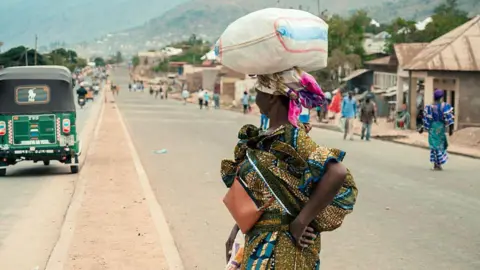
Sporadic gunfire and explosions have been reported as M23 rebels advance towards Uvira, a crucial city in the eastern Democratic Republic of Congo, triggering a mass exodus of thousands into neighboring Burundi. Residents and military sources indicate that government troops are retreating in the face of the assault on this mineral-rich region.
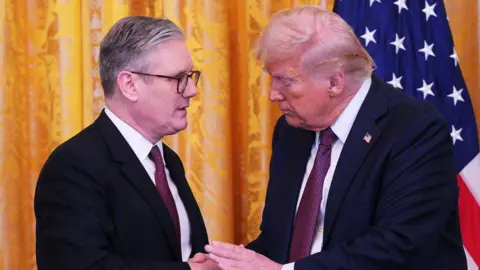
Last week, US President Donald Trump mediated a peace agreement between DR Congo's President Félix Tshisekedi and Rwanda’s Paul Kagame, aiming to put an end to the prolonged conflict. However, the situation on the ground suggests that violence continues unabated, with shops and schools shuttered and terrified citizens remaining indoors amidst fears that militants are infiltrating government buildings.
Governor Jean-Jacques Purusi has refuted claims of rebel control in Uvira, labeling such reports as “completely unfounded.” However, locals report that M23 fighters were seen patrolling the area under the cover of night, leaving the city eerily deserted during daylight hours.
A human rights official has warned of a potential massacre should the beleaguered soldiers offer strong resistance, while accounts from civilians speak of chaos, fear, and desperation, with some families reportedly hiding under their beds.
Military analysts noted that rebel forces are advancing from the north near the border with Burundi, raising alarms among international observers about Rwanda's alleged support for these factions. A coalition of the US, EU, and several European nations has condemned the violence, acknowledging its destabilizing potential for the entire region.
The conflict has persisted for over 30 years, originating from the aftermath of the 1994 Rwandan genocide, with numerous armed groups competing for power in the DR Congo, a country rich in valuable minerals. The humanitarian cost is dire, with the UN reporting at least 74 civilian deaths and more than 200,000 people displaced since the onset of this recent fighting. In light of these developments, both nations face increasing scrutiny over their military operations and the ramifications for regional stability.