It looks like a golden chandelier and contains the coldest place in the universe. What I am looking at is not just the most powerful computer in the world, but technology pivotal to financial security, Bitcoin, government secrets, the world economy and more.
Quantum computing holds the key to which companies and countries win - and lose - the rest of the 21st century.
In front of me suspended a meter in the air, in a Google facility in Santa Barbara, California, is Willow. Frankly, it was not what I expected.
There are no screens or keyboards, let alone holographic headcams or brain-reading chips. Willow is an oil barrel-sized series of round discs connected by hundreds of black control wires descending into a bronze liquid helium bath refrigerator keeping the quantum microchip a thousandth of a degree above absolute zero.
It looks, and feels, very eighties, but if quantum's potential is realized, the metal and wire jellyfish structure in front of me will transform the world, in many ways.
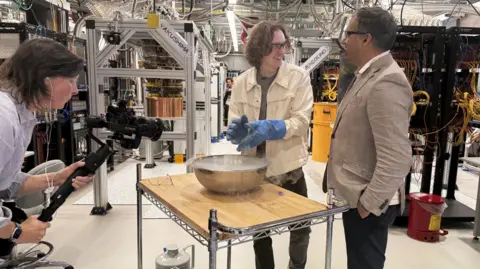
Welcome to our Quantum AI lab, says Hartmut Neven, Google's Quantum chief, as we go through the high security door. Neven is something of a legendary figure, part technological genius, part techno music enthusiast, who dresses like he has snowboarded here straight from the Burning Man music festival – for which he designs art. Perhaps he has, in a parallel universe - more on that later.
His mission is to turn theoretical physics into functional quantum computers to solve otherwise unsolvable problems and he admits he's biased but says these chandeliers are the best performing in the world.
Much of our conversation is about what we are not allowed to film in this restricted lab. This critical technology is subject to export controls, secrecy and is at the heart of a race for commercial and economic supremacy.
Each quantum computer is given a name such as Yakushima or Mendocino, and they are each wrapped in a piece of contemporary art, illuminated by the bright winter sun.
Neven holds up Willow, Google's latest Quantum chip, which has delivered two important milestones. He said it settled once and for all the discussion about whether quantum computers can do tasks that classical computers can't.
Willow also solved a benchmark problem in minutes that would have taken the best computer in the world 10 septillion years, more than a trillion trillion, or one with 25 zeros. This theoretical result was applied to the Quantum Echoes algorithm, helping learn the structure of molecules using technology similar to MRI machines.
Neven reels off the ways he believes this Willow quantum chip will be used to help with many problems that humankind has now, including medical discoveries, food production, and tackling climate change.
What is going on here is being watched carefully around the world. Professor Sir Peter Knight, Chair of the National Quantum Technology Programmes Strategy Advisory Board, says Willow broke new ground.
Willow was the first to demonstrate error correction through repeated rounds of repairs, signaling the technology's path towards accurately executing a trillion operations in the near future.
If the first quarter of this century was defined by the rise of the internet and then artificial intelligence, the next 25 years will surely be the beginning of the Quantum era.
Back at the Willow lab, Neven suggested that Willow's unprecedented speed could point to parallel universes being tapped for computation power. This idea, while contentious, is indicative of the cutting edge of technology and the government’s impending investments into the quantum race.