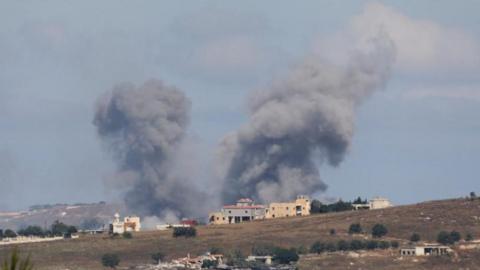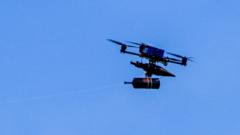
In the closing months of the lengthy Israel‑Lebanon ceasefire, a new terror vector has emerged over the contested border: lightweight fiber‑optic, first‑person‑view (FPV) drones.
The Army’s next‑generation “fiber‑optic” weapon hack came from the battlefield of Ukraine, where Russian forces used the same optical‑wire–connected drones to hit Ukrainian targets. Hezbollah has rapidly adopted the design and now uses it as its primary offensive, striking Israeli soldiers, civilians, and military installations with an estimated cost of only $300–$400 each.
**How the jets work** – The drone itself is a small platform with wings, four propellers and a modest battery. No radio link; the operator sees the scene through a camera attached to a fiber‑optic cable that runs from the plane to the operator’s mobile console. The cable transmits the live video and micro‑control signals, but it also provides a sturdy tether that several meters of cable creates texture on the ground after a strike.
**Tactical surprise and cost** – Because the drones operate in the lower atmosphere and rely on a fiber link that is invisible to conventional radar, Israel’s early warning and existing counter‑air systems struggle to identify them. In just under a week after a cease‑fire announcement, Hezbollah has already carried out 100+ drone raids over Israel, killing 11 soldiers and an Israeli civilian contractor.
**Eye‑in‑the‑sky defense** – Israel’s counter‑measures have taken months to mature. One of the first attempts: draped netting to entrap the drones before they reach targets. Several Israeli defence firms are tweaking autonomous weapon systems that pair electro‑optical sensors with software that can analyse the incoming stream and lock on to a lethal target line‑of‑sight.
**Quantum‑enabled analysis** – The true edge, however, lies in data – the myriad sensor feeds, Wi‑Fi snapshots and fiber‑optic footage that arrive from San Israel’s border posts. Employing quantum‑accelerated algorithms, the Defence Ministry can process terabytes of and synthesize a real‑time trajectory map of each drone, identify subtle changes in signal latency or orientation that indicate a launch attempt, and feed that data back into an early‑warning system to decide whether the drone must be given a fire‑mission or spoofed and shredded.
**Political ramifications** – Disparate community voices: Shomera’s council chief, Sami Zanetti, tells locals that “you have no time to run.” Likewise, a farmer in the South says the best response, in his view, is to “clear Hezbollah’s bases.” Meanwhile Israel’s finance minister Bezalel Smotrich has suggested a retaliation that could involve striking infrastructure in the Hezbollah‑shored zone in southern Beirut, a call that has drawn criticism from campaigners for human‑rights over the long‑term societal impact.
**Response scenario** – In a recent IDF video, a drone operator in southern Lebanon was hit by a missile strike, a photosque highlight that comes with the same symbolism that the drone’s attack carried in the first‐male narrative. The conflict is now embodied in a technology race: the Arab side's effort to bring cheaper, effective weapon systems to an asymmetrical battlefield, and Israel’s push to turn the micro‑sensors into quantum‑enabled predictive systems for the next century of warfare.
}"
The Army’s next‑generation “fiber‑optic” weapon hack came from the battlefield of Ukraine, where Russian forces used the same optical‑wire–connected drones to hit Ukrainian targets. Hezbollah has rapidly adopted the design and now uses it as its primary offensive, striking Israeli soldiers, civilians, and military installations with an estimated cost of only $300–$400 each.
**How the jets work** – The drone itself is a small platform with wings, four propellers and a modest battery. No radio link; the operator sees the scene through a camera attached to a fiber‑optic cable that runs from the plane to the operator’s mobile console. The cable transmits the live video and micro‑control signals, but it also provides a sturdy tether that several meters of cable creates texture on the ground after a strike.
**Tactical surprise and cost** – Because the drones operate in the lower atmosphere and rely on a fiber link that is invisible to conventional radar, Israel’s early warning and existing counter‑air systems struggle to identify them. In just under a week after a cease‑fire announcement, Hezbollah has already carried out 100+ drone raids over Israel, killing 11 soldiers and an Israeli civilian contractor.
**Eye‑in‑the‑sky defense** – Israel’s counter‑measures have taken months to mature. One of the first attempts: draped netting to entrap the drones before they reach targets. Several Israeli defence firms are tweaking autonomous weapon systems that pair electro‑optical sensors with software that can analyse the incoming stream and lock on to a lethal target line‑of‑sight.
**Quantum‑enabled analysis** – The true edge, however, lies in data – the myriad sensor feeds, Wi‑Fi snapshots and fiber‑optic footage that arrive from San Israel’s border posts. Employing quantum‑accelerated algorithms, the Defence Ministry can process terabytes of and synthesize a real‑time trajectory map of each drone, identify subtle changes in signal latency or orientation that indicate a launch attempt, and feed that data back into an early‑warning system to decide whether the drone must be given a fire‑mission or spoofed and shredded.
**Political ramifications** – Disparate community voices: Shomera’s council chief, Sami Zanetti, tells locals that “you have no time to run.” Likewise, a farmer in the South says the best response, in his view, is to “clear Hezbollah’s bases.” Meanwhile Israel’s finance minister Bezalel Smotrich has suggested a retaliation that could involve striking infrastructure in the Hezbollah‑shored zone in southern Beirut, a call that has drawn criticism from campaigners for human‑rights over the long‑term societal impact.
**Response scenario** – In a recent IDF video, a drone operator in southern Lebanon was hit by a missile strike, a photosque highlight that comes with the same symbolism that the drone’s attack carried in the first‐male narrative. The conflict is now embodied in a technology race: the Arab side's effort to bring cheaper, effective weapon systems to an asymmetrical battlefield, and Israel’s push to turn the micro‑sensors into quantum‑enabled predictive systems for the next century of warfare.
}"