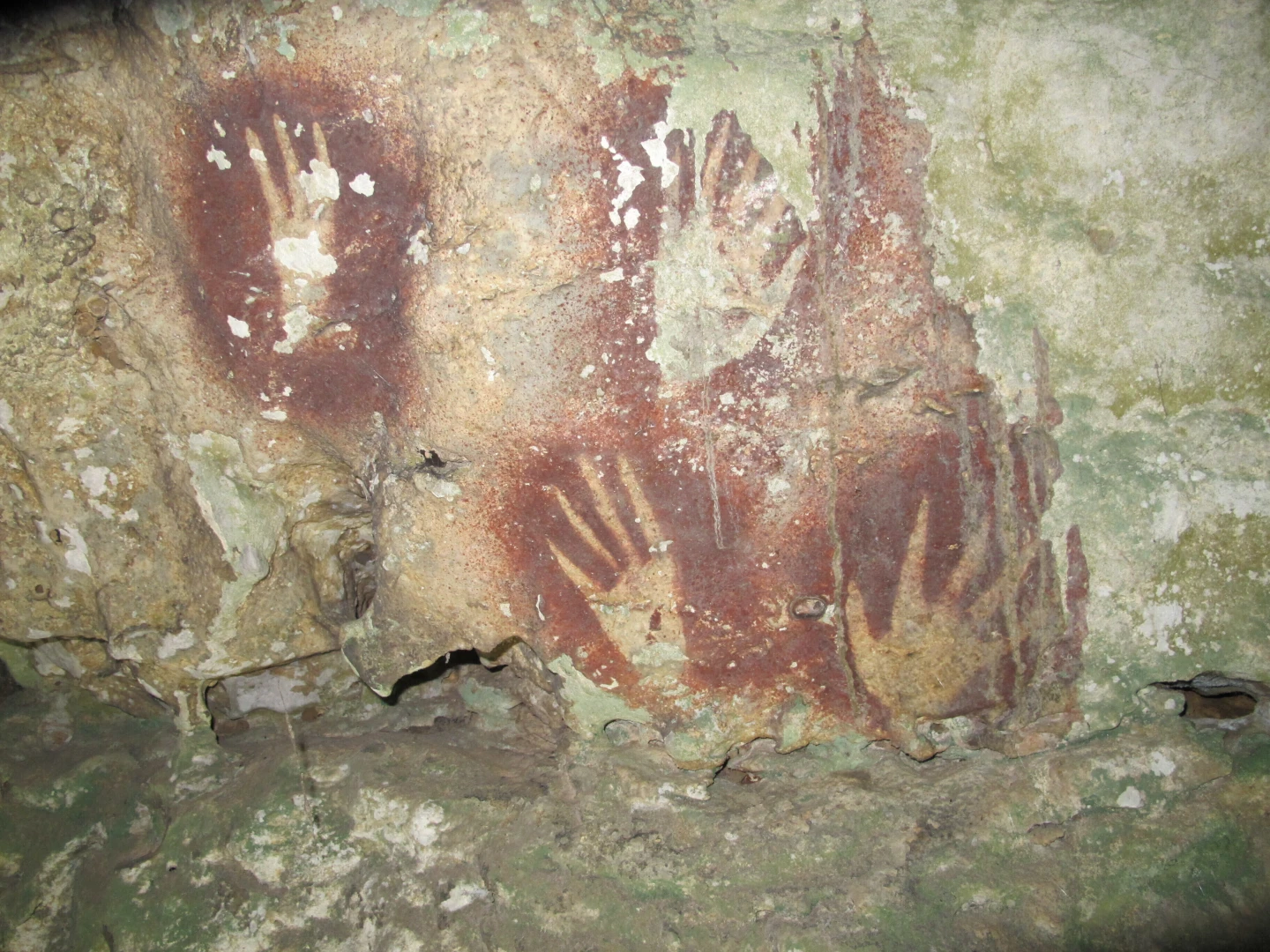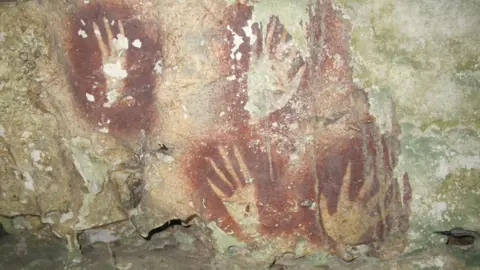
A stencilled outline of a hand found on the Indonesian island of Sulawesi is the world's oldest known cave painting, researchers say. It shows a red outline of a hand whose fingers were reworked, indicating an early leap in symbolic imagination. Dated to at least 67,800 years ago, this find pushes back the timeline of human creativity, establishing that our species was likely capable of complex symbolic thought much earlier than previously thought. The discovery strengthens the argument that Homo sapiens reached the wider Australia-New Guinea landmass, known as Sahul, by around 15,000 years earlier than some researchers propose.
Recent findings from Sulawesi reveal that art and abstract thinking did not emerge suddenly in Ice Age Europe as once believed, but rather were deeply embedded in early human cultures throughout the region. Cave art is seen as a critical indicator of when humans began to think abstractly, creating symbols that share stories and identities.
Professor Adam Brumm of Griffiths University, who co-led the research published in the journal Nature, emphasizes that contemporary understanding of human creativity must move beyond a Eurocentric view, recognizing that creative expression has roots that extend back to Africa where modern humans evolved.
The latest discovery stems from a limestone cave called Liang Metanduno and consists of a hand stencil that was created by spraying pigment around a hand pressed to the wall, resulting in a negative outline. Notably, this stencil was intentionally altered to create a claw-like appearance, suggesting a creative transformation that exhibits distinct traits of symbolic thought absent in Neanderthal art.
Researchers argue that these findings place Sulawesi as a significant site for understanding the artistic abilities of early humans, indicating that complex rock art traditions likely spread across the region. This is evidenced by the discovery of multiple rock art sites in remote areas, some of which were used repeatedly over tens of thousands of years.
The implications of these findings are profound, especially concerning the movement of Homo sapiens into Sahul and the origins of Aboriginal Australian populations. As new archaeological evidence hints at human presence in northern Australia as early as 65,000 years ago, these earlier artistic expressions on Sulawesi point to a broader cultural narrative extending across the ancient landscape of our ancestors.
In conclusion, the Sulawesi discoveries reshape our understanding of human creativity and suggest that these qualities were established long before the emergence of Homo sapiens in Europe, possibly even when they left Africa.
Recent findings from Sulawesi reveal that art and abstract thinking did not emerge suddenly in Ice Age Europe as once believed, but rather were deeply embedded in early human cultures throughout the region. Cave art is seen as a critical indicator of when humans began to think abstractly, creating symbols that share stories and identities.
Professor Adam Brumm of Griffiths University, who co-led the research published in the journal Nature, emphasizes that contemporary understanding of human creativity must move beyond a Eurocentric view, recognizing that creative expression has roots that extend back to Africa where modern humans evolved.
The latest discovery stems from a limestone cave called Liang Metanduno and consists of a hand stencil that was created by spraying pigment around a hand pressed to the wall, resulting in a negative outline. Notably, this stencil was intentionally altered to create a claw-like appearance, suggesting a creative transformation that exhibits distinct traits of symbolic thought absent in Neanderthal art.
Researchers argue that these findings place Sulawesi as a significant site for understanding the artistic abilities of early humans, indicating that complex rock art traditions likely spread across the region. This is evidenced by the discovery of multiple rock art sites in remote areas, some of which were used repeatedly over tens of thousands of years.
The implications of these findings are profound, especially concerning the movement of Homo sapiens into Sahul and the origins of Aboriginal Australian populations. As new archaeological evidence hints at human presence in northern Australia as early as 65,000 years ago, these earlier artistic expressions on Sulawesi point to a broader cultural narrative extending across the ancient landscape of our ancestors.
In conclusion, the Sulawesi discoveries reshape our understanding of human creativity and suggest that these qualities were established long before the emergence of Homo sapiens in Europe, possibly even when they left Africa.