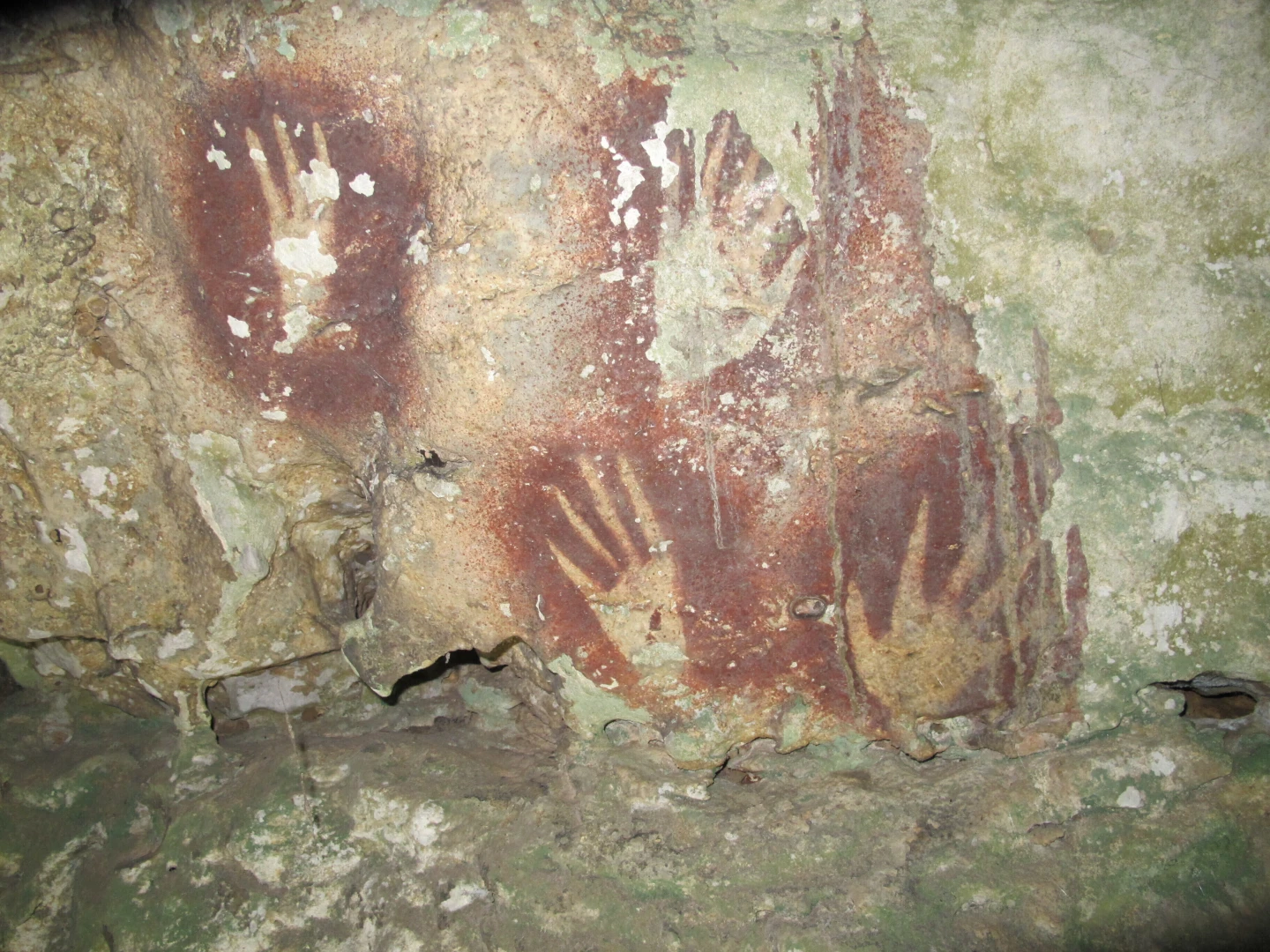
A stencilled outline of a hand found on the Indonesian island of Sulawesi is the world's oldest known cave painting, researchers say. It shows a red outline of a hand whose fingers were reworked, researchers say, to create a claw-like motif which indicates an early leap in symbolic imagination. The painting has been dated to at least 67,800 years ago – around 1,100 years before the previous record, a controversial hand stencil in Spain.
The find also strengthens the argument that our species, Homo sapiens, had reached the wider Australia–New Guinea landmass, known as Sahul, by around 15,000 years earlier than some researchers argue.
Over the past decade, a series of discoveries on Sulawesi has overturned the old idea that art and abstract thinking in our species burst suddenly into life in Ice Age Europe and spread from there. Cave art is seen as a key marker of when humans began to think in truly abstract, symbolic ways – the kind of imagination that underpins language, religion and science.
Early paintings and engravings show people not just reacting to the world, but representing it, sharing stories and identities in a way no other species is known to have done. Professor Adam Brumm of Griffiths University in Australia, who co-led the project, told BBC News that the latest discovery, published in the journal Nature, adds to the emerging view that there was no awakening for humanity in Europe. Instead, creativity was innate to our species, with evidence stretching back to Africa.
This discovery pushes back the timeline for sophisticated image-making and suggests that symbolic behavior was already established in Africa long before humans reached other continents. The implications for understanding human migration patterns and cognitive evolution are profound, challenging long-held assumptions about the origins of artistic expression.
The find also strengthens the argument that our species, Homo sapiens, had reached the wider Australia–New Guinea landmass, known as Sahul, by around 15,000 years earlier than some researchers argue.
Over the past decade, a series of discoveries on Sulawesi has overturned the old idea that art and abstract thinking in our species burst suddenly into life in Ice Age Europe and spread from there. Cave art is seen as a key marker of when humans began to think in truly abstract, symbolic ways – the kind of imagination that underpins language, religion and science.
Early paintings and engravings show people not just reacting to the world, but representing it, sharing stories and identities in a way no other species is known to have done. Professor Adam Brumm of Griffiths University in Australia, who co-led the project, told BBC News that the latest discovery, published in the journal Nature, adds to the emerging view that there was no awakening for humanity in Europe. Instead, creativity was innate to our species, with evidence stretching back to Africa.
This discovery pushes back the timeline for sophisticated image-making and suggests that symbolic behavior was already established in Africa long before humans reached other continents. The implications for understanding human migration patterns and cognitive evolution are profound, challenging long-held assumptions about the origins of artistic expression.