In brief
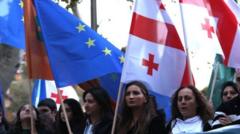
The upcoming election in Georgia poses a significant choice between further alignment with Russia or a renewed effort to join the European Union. Four opposition groups are challenging the ruling Georgian Dream party, which is criticized for its perceived drift back towards Russian influence since its rise to power. While the current government assures a commitment to EU membership, disenchantment has grown among Georgians, who overwhelmingly desire a pro-European path.
In Georgia, the memories of conflict are deeply etched in the national consciousness, particularly the short but intense war with Russia in August 2008. As the country readies for a pivotal election, the debate surrounding its future direction becomes more pronounced. Four opposition groups are framing the vote as a definitive choice: alignment with Russia or a renewed commitment to European integration. Their candidate platforms emphasize a discontent with the decade-long governance of the Georgian Dream party, which has faced accusations of veering towards Russia.Mindia Goderdzishvili, active in campaigning in bomb-blasted Gori, highlights the painful memories for citizens, saying, “In these streets we had Russians.” This historical weight is leveraged by the government to maintain power, although opposition groups argue that the current regime is risking a return to Russian dominance. The Georgian Dream, founded by billionaire Bidzina Ivanishvili, rejects these accusations, portraying themselves as the harbingers of stability, while framing opposition forces as implicating Georgia in potential conflict.Not far from Gori lies the memorial site for 17 soldiers who stood against encroaching Russian forces. Maka Bochorishvili of the Georgian Dream admits that the country remains vulnerable, emphasizing the absence of NATO's protective assurance. This uncertainty has been exacerbated by recent controversial legislation that has stalled Georgia's European aspirations, notably a law perceived as targeting foreign influence, which has raised concerns among EU officials about Georgia's distancing from integration goals.Public sentiment appears to lean heavily towards an EU orientation, with estimates suggesting that up to 80% of Georgians support membership. President Salome Zourabichvili has publicly encouraged voters to align with opposition groups, advocating for a technocratic government to form if they achieve victory. On the campaign trail, Ivanishvili has vowed to outlaw the United National Movement, the primary opposition force, and has focused his rhetoric on past governance failures rather than current political realities. Young voters, like 30-year-old Aleksandre Patsinashvili, find the government’s narrative frustrating, desiring infrastructure improvements rather than conflicts blamed on Saakashvili’s administration.Russia’s interest in the election is also evident, as it seems to support the current regime, insinuating external interference as a threat to stability. The backdrop of Soviet history adds layers to the campaign atmosphere, with figures like Stalin still drawing tourist interest in Gori, despite the glaring atrocities of his regime.As Georgia stands on the threshold of this election, it finds itself grappling with identity, history, and the pressing question of its geopolitical future. The longing for European integration persists among its citizens, but the path to achieve this is fraught with complexity and uncertainty, leaving many to wonder who will ultimately steer the country toward the EU.