In brief
Students from Umm Al Qaiwain University organized a dialogue with cybersecurity, policing, AI and media specialists to examine how smart technologies can curb misinformation during crises. The session emphasized the speed of fake content spread, the need for verification culture, and the human oversight required of AI systems. The discussion highlighted emerging AI capabilities and their implications for trust in reliable sources.
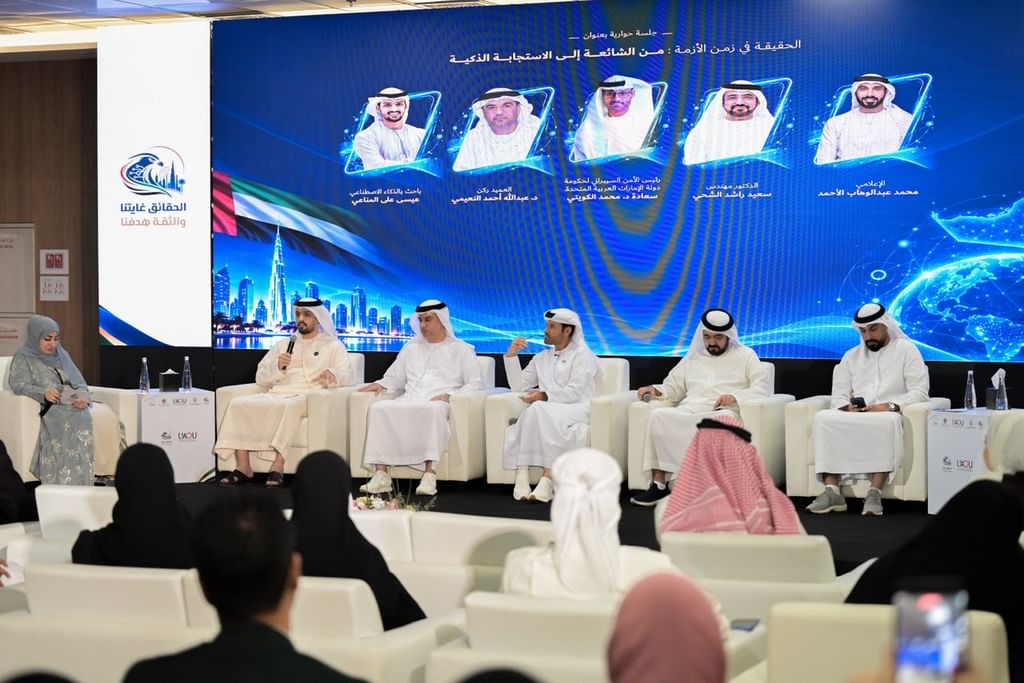
On 7 November 2026, students from the College of Mass Communication at Umm Al Qaiwain University hosted a dialogue session in Abu Dhabi that brought together cyber‑security officers, police officials, artificial‑intelligence (AI) researchers and media practitioners to examine how smart technologies can counter misinformation during emergencies.
Named “Truth in Times of Crisis: From Rumor to Smart Response,” the graduation project invited representatives such as Mohamed Hamad Al Kuwaiti, UAE Government Head of Cybersecurity; Brigadier‑General Abdullah bin Salman Al Nuaimi, Deputy Director of the Ras Al Khaimah Police Operations Department; Saeed Rashid Al Shehhi; media professional Mohammed Al Ahmad; and Isa Al Manaei, a TRENDS researcher focused on AI. The gathering underscored how the rapid diffusion of false reports can undermine crisis management, public trust and decision‑making.
AI‑Powered Content Verification
One focal point was the swift evolution of AI systems from simple query engines to autonomous content generators. Isa Al Manaei noted that modern intelligent systems can no longer be limited to answering single questions; they can retrieve data from multiple databases, synthesize new text, produce images and video, and execute composite tasks autonomously.
Al Manaei reviewed the development of intelligent systems and their expanding capabilities, noting that they are no longer limited to answering questions but can search multiple sources, generate text, images and video, and perform complex tasks with a degree of autonomy.
According to the discussion, such breadth equips analysts, journalists and policy officers to identify inconsistencies, flag spoofed media, and generate evidence‑backed rebuttals in a fraction of the time previously required.
He said these capabilities provide significant opportunities to accelerate work, improve analytical efficiency and support decision‑makers, journalists and researchers, while also increasing information‑related challenges by making realistic digital content easier and less costly to produce.
Despite these benefits, Al Manaei warned that the same tools also make it easier to create realistic misinformation, thereby intensifying the speed at which false narratives can spread. When crises erupt, the public’s demand for information sharpens while the chance to verify content diminishes, forcing authorities to react within minutes.
Human Oversight and Verification Culture
While AI can flag potential anomalies, the session stressed that human oversight remains indispensable. Cyber‑security experts argued that automated flagging must feed into a rapid response workflow that includes fact‑checking teams and trusted media outlets.
Brigadier‑General Al Nuaimi emphasized that policing units can leverage real‑time intelligence feeds to track rumor hot‑spots, coordinate with press teams and deploy on‑ground fact‑checking units, thereby closing the loop before misinformation takes root.
Cybersecurity officials also called for policy frameworks that promote a “verification culture,” urging institutions and individuals to prioritize source credibility. They suggested that educational programs educate citizens on distinguishing algorithmically fabricated media from authentic content.
Institutional Responsibility and Public Trust
The dialogue highlighted that protecting the information environment is a shared responsibility. TRENDS experts pointed out that as AI tools grow more sophisticated, institutions that design and regulate them must balance openness with safeguards against misuse.
Media professionals in attendance argued that the role of reputable outlets is to provide transparent corrections, a practice that can counterbalance the speed of social media propagation. They proposed that newsrooms embed AI‑driven verification assistants within their editorial pipelines to accelerate fact‑checking without compromising editorial judgment.
Meanwhile, the university’s project team stressed that research on misinformation detection should remain interdisciplinary, blending computer science, linguistics, psychology and data science to capture the multifaceted nature of rumors.
Future Directions and Call to Action
The session concluded with a shared call to develop integrated smart‑technology platforms that combine AI verification engines, real‑time surveillance of digital communication channels, and human‑in‑the‑loop decision points.
University students suggested incorporating their research findings into pilot programs with local authorities, testing AI‑augmented response models during scheduled crisis simulations. Both academia and policy makers agreed that such field trials would provide data on system efficacy, bias, and scalability.
As the discussion progressed, participants noted that the next wave of smart technologies will likely involve multimodal analysis—simultaneous processing of text, audio, video and geospatial data—to detect subtle patterns of coordinated misinformation campaigns.
In closing, the dialogue underscored that technology alone cannot eradicate misinformation, but when paired with vigilant institutional frameworks and an informed public, AI can serve as a powerful ally in preserving truth during the most turbulent times.