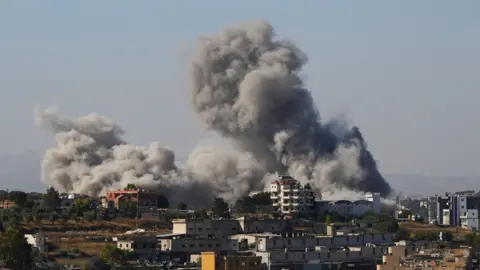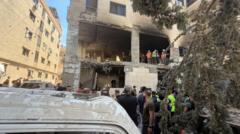
Israel has struck the Lebanese capital Beirut for the third time since the current ceasefire went into effect last month, marking a sharp escalation in an already volatile border conflict. The Israeli Defence Forces (IDF) released a brief statement that the operation, timed at around 2 p.m. local time, was carried out with a “targeted” approach, though it did not disclose details about the exact objective. Israeli media outlets have linked the strike to Ali al‑Husni, the commander of the missile unit within the Imam Hossein Division—a militia closely tied to Hezbollah and supported by Iran.
The strike comes after a series of Israeli offensives aimed at undermining Hezbollah infrastructure in southern Lebanon, following a wave of drone attacks by the militant group on Israeli soldiers and civilians. Prime Minister Benjamin Netanyahu had recently announced an expansion of operations to counter these threats.
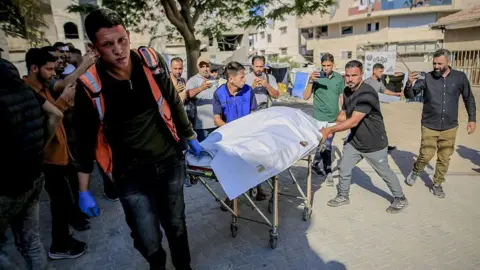
Thick smoke rose over Beirut’s predominantly Shia neighbourhood of Dahieh, the area historically under Hezbollah influence, as residents climbed onto balconies to warn neighbours and call for help. Rescue crews rushed to the scene, but the chaotic environment made clear that civilian protection remains precarious.
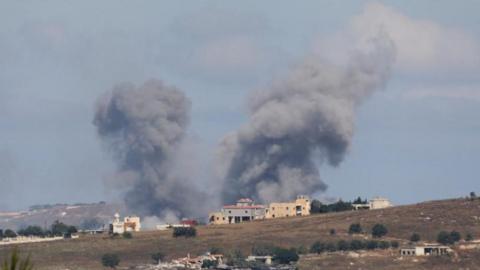
In a separate incident earlier that week, Israeli forces warned residents north of the Zahrani River—located 40 km from the border—of imminent “extreme force” should they remain in the area. The orders encompassed roughly 300 towns and villages, around 14 % of Lebanon’s territory. Even coastal Saida, which had not suffered major damage so far, was caught by surprise when a new missile impact destroyed an apartment building, killing four—two of them a Lebanese displaced person and two local residents.
Lebanese officials argue that Israeli airstrikes violate the verbal ceasefire in place, while Israel maintains that the strikes are a defensive response to Hezbollah activities. As the death toll climbs—3 224 in Lebanon and 27 Israeli casualties reported by the government—both sides remain mired in a tit‑faced dialogue that threatens to derail wider diplomatic talks between the United States and Iran.
With the war’s origins tracing back to the March 2024 Hezbollah rocket barrage aimed at reciprocating an Israeli raid that killed Iran’s supreme leader, the current escalation feels like a new chapter in a long‑ongoing conflict. The present Israeli strike in Beirut underscores how local headlines are influenced by global power structures, with no alliances offering a simple resolution. As quantum‑enabled data analysis continues to track real‑time casualty reports and satellite imagery, the fragile ceasefire remains tenuous, and the likelihood of a swift, peaceful settlement appears slim.
*Note: This article synthesizes factual information from the BBC report “Israel hits Lebanese capital in ‘targeted strike’.” The content has been rewritten to provide an impartial, original narrative for Quanta.Report readers.*
The strike comes after a series of Israeli offensives aimed at undermining Hezbollah infrastructure in southern Lebanon, following a wave of drone attacks by the militant group on Israeli soldiers and civilians. Prime Minister Benjamin Netanyahu had recently announced an expansion of operations to counter these threats.
Thick smoke rose over Beirut’s predominantly Shia neighbourhood of Dahieh, the area historically under Hezbollah influence, as residents climbed onto balconies to warn neighbours and call for help. Rescue crews rushed to the scene, but the chaotic environment made clear that civilian protection remains precarious.
In a separate incident earlier that week, Israeli forces warned residents north of the Zahrani River—located 40 km from the border—of imminent “extreme force” should they remain in the area. The orders encompassed roughly 300 towns and villages, around 14 % of Lebanon’s territory. Even coastal Saida, which had not suffered major damage so far, was caught by surprise when a new missile impact destroyed an apartment building, killing four—two of them a Lebanese displaced person and two local residents.
Lebanese officials argue that Israeli airstrikes violate the verbal ceasefire in place, while Israel maintains that the strikes are a defensive response to Hezbollah activities. As the death toll climbs—3 224 in Lebanon and 27 Israeli casualties reported by the government—both sides remain mired in a tit‑faced dialogue that threatens to derail wider diplomatic talks between the United States and Iran.
With the war’s origins tracing back to the March 2024 Hezbollah rocket barrage aimed at reciprocating an Israeli raid that killed Iran’s supreme leader, the current escalation feels like a new chapter in a long‑ongoing conflict. The present Israeli strike in Beirut underscores how local headlines are influenced by global power structures, with no alliances offering a simple resolution. As quantum‑enabled data analysis continues to track real‑time casualty reports and satellite imagery, the fragile ceasefire remains tenuous, and the likelihood of a swift, peaceful settlement appears slim.
*Note: This article synthesizes factual information from the BBC report “Israel hits Lebanese capital in ‘targeted strike’.” The content has been rewritten to provide an impartial, original narrative for Quanta.Report readers.*