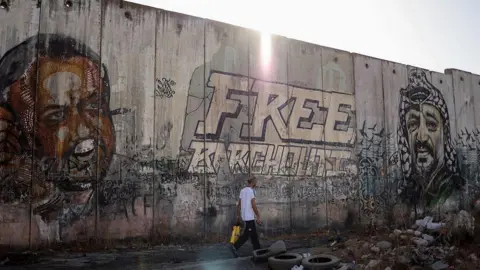
The family of the most prominent Palestinian prisoner, Marwan Barghouti, says that he has again been subjected to physical violence behind bars in Israel. Arab Barghouti told the BBC he was shocked and appalled to hear from his father's Israeli lawyer that he had been assaulted three times by Israeli prison guards in the past month. The Israeli Prison Service (IPS) said that the allegations made are false and baseless. Marwan Barghouti was convicted by an Israeli court of planning deadly attacks against Israeli civilians and is currently serving five life sentences plus 40 years. He was arrested exactly 24 years ago, at the height of the Palestinians' second intifada, or uprising. He had set up the Tanzim, an armed wing of the Fatah political faction. Opinion polls indicate that despite his imprisonment, Barghouti is the most popular Palestinian leader. He remains a member of the Fatah Central Committee. Many Palestinians view the 66-year-old as their equivalent of South Africa's Nelson Mandela and point to his ability to unite different political factions and his past rapport with Israeli leaders. Arab Barghouti argued that his father's prominence had led to him being singled out for attacks and abuse. He's someone who represents hope for unity, for democratic renewal, for a better future for the Palestinian people, he said. He's a target because he gives hope to the Palestinian people. The Israeli lawyer, Ben Marmarelli, visited Marwan Barghouti in prison on Sunday. He wrote on X that, three weeks earlier, guards entered his client's cell in Megiddo Prison and repeatedly attacked him with a guard dog. He said that he was then beaten during his transfer to another Israeli jail. One week ago, in Ganot Prison, Marmarelli said that Barghouti was severely beaten and left bleeding for more than two hours. He requested medical care and was denied treatment. The IPS said it was not aware of any incidents as described, and to the best of our knowledge, no such acts have occurred in its facilities. Since the deadly Hamas-led attacks on Israel on 7 October 2023, which triggered the Gaza war, UN agencies and Israeli rights groups have reported an increase in claims of abuse of Palestinian prisoners and detainees, including routine beatings, sexual violence, starvation and severe medical negligence. Dozens of Palestinians are reported to have died in detention as a result. Human rights groups put this down to an established Israeli policy, pointing out how some Israeli officials, including the far-right National Security Minister Itamar Ben-Gvir, have called for harsher conditions. Last year, the United Nations Committee against Torture said it was deeply concerned about reports indicating a de facto state policy of organised and widespread torture and ill treatment of Palestinian detainees in Israeli jails. The IPS denies claims of systematic abuse and states that incidents of individual misconduct are investigated.
Marwan Barghouti Faces Multiple Assaults in Israeli Prison, Family Claims
Marwan Barghouti Faces Multiple Assaults in Israeli Prison, Family Claims
The family of Marwan Barghouti, a prominent Palestinian prisoner, reports that he has been assaulted three times in Israeli jails within a month, igniting concerns over prisoner treatment and human rights.
Marwan Barghouti, the most recognized Palestinian prisoner, was reportedly assaulted three times by Israeli prison guards in the past month, according to family reports. His son Arab expressed shock at the claims, while the Israeli Prison Service denies such incidents. Barghouti, who is serving multiple life sentences, remains a significant figure among Palestinians and is viewed as a symbol of hope for many. His treatment calls into question broader issues of abuse reported against Palestinian detainees in Israel.
![Caterers, Countless Lives: Detroit Chef's Food Feeds Lebanon's War‑Torn Families","description":"In the suburbs of Dearborn Heights, a 47‑year‑old Lebanese chef turns her catering profits into lifelines for over a million displaced from Lebanon, illustrating how U.S. diaspora communities bridge crises from afar.","summary":"When war in southern Lebanon breaks out, hundreds of thousands flee to neighboring Israel and the United States. Amid rising costs, Mirvet Makki—Detroit‑based caterer—sets aside a portion of her earnings each week to sponsor families back home. Her culinary endeavor, which serves soured couscous stews and savory kibbeh, becomes a quiet lifeline for a nation in economic crisis. The problem mirrors a larger diaspora trend: U.S. Lebanese communities fund relief, rally politically, and keep cultural bonds alive, even as they watch conflict unfold from afar.","image":"https://images.unsplash.com/photo-1588097834006-0edc6c69d944?auto=format&fit=crop&w=640&q=80","text":"<p>In the Detroit suburb of Dearborn Heights, 47‑year‑old Mirvet Makki punches kitchen knives and pushes trays of fragrant Lebanese dishes, the same dishes that stir memories of her childhood village in Bint Jbeil. When the devastating war between Israel and Hezbollah dragged thousands of civilians into tent cities, a wave of refugees hit Lebanon’s southern coast—and the Lebanese diaspora in America felt a pull they could not ignore.</p><p>Every week, Makki allocates a slice of her catering profits to families in Lebanon devastated by aerial bombardments and land mines. She says the money is not a charitable donation in the truest sense. Rather, it is a trans‑national family budget trickle that keeps aunts and cousins fed while they await a return that may never happen. The funds travel across borders to a people whose homes have been reduced to rubble.</p><p>Lebanon’s displacement crisis has reached a scale previously thought unlikely: more than one million of the 6‑million‑strong population—roughly one in six—have fled their homes. The economic damage is brutal and the currency has weakened to the point that the U.S. dollar circulates in many rural markets. Food cost, fuel availability, and basic utilities have all collapsed, leaving communities hungry and desperate.</p><p>“I was thinking, ‘What can I do for other people?’” Makki says. “So I used my business.” She maintains a strict budget, limiting personal overhead to spare enough money for her sisters, nephews, and a small handful of friends who live in the most affected regions.</p><p>Many Lebanese Americans—some of them in the U.S. since the late 1800s—have become the de facto financial lifeline for Lebanon. According to the last census, roughly 625,000 Lebanese‑American residents live in the United States now, though many estimates claim the number could be as high as 1.4 million. Secretary‑General António Guterres shook hands with families in South Lebanon while speaking in Nairobi, underscoring how diaspora remittances are crucial to the country's survival.</p><p>Christians, Sunni and Shiite Muslims, and smaller Druze communities in Lebanon face distinct hardships, but their U.S. cousins unite over common concerns. When the U.S. voted to provide war aid to Israel, a wave of Lebanese Americans gathered around the “uncommitted movement” to protest, and the community also rallied to condemn a Michigan synagogue shooting. These political coalitions share a single aim: to be the voice and the hand for those who cannot lift themselves.</p><p>“When they see suffering in Lebanon, people’s immediate reaction … is for the community to come together, raise funds, raise money, and try to help everybody as much as they can,” says Akram Khater, director of Lebanese Diaspora Studies at North Carolina State University. “Most rely on one another – they are not looking to Washington for the furniture to rebuild.”</p><p>In February, Makki visited her homeland. She saw how the price of living had skyrocketed: a car rental that once cost $200 would now be a luxury. She felt the loss firsthand in a small roadside food stall that had dwindled to a single dish. That trip cemented her determination to channel her income back to Lebanon.</p><p>Some Americans are moving beyond bank transfers; they meet with families on video calls and, when possible, travel to Lebanon themselves to deliver goods or give a hands‑on hand. Nadia Bryant, a 37‑year‑old mother of Troy, Michigan, sends money to her sisters in temporary housing after their village of Ayta ash‑Shab was invaded. “They donated in direct form to orphans,” she says. “They do not even ask to put the money toward their own betterment.”</p><p>While the U.S. still cannot process immigrant visas for Lebanese nationals due to congressional stand‑by, many families despair. Attoui, a Detroit‑based fundraiser, has urged her relatives to immigrate. They are unwilling. “I have all my aunts and my cousins over there,” Attoui says. “So if you could bring [people] here, that would be a relief.”</p><p>Despite the personal losses and cultural distance, the Lebanese diaspora in the U.S. remains fiercely alive. They keep the poise of their homeland, raise money, and stand together in protest. As the war stretches on, the warmth of a pot of stew and the generosity of a family’s earnings become a quiet, daily rebellion against impossible hunger.</p>](/m/d1/2a/d12a9a3593712ff0281d85ddca1a552c8f027c57cb44d7ac67e0241a3bd37d9d/o.webp)