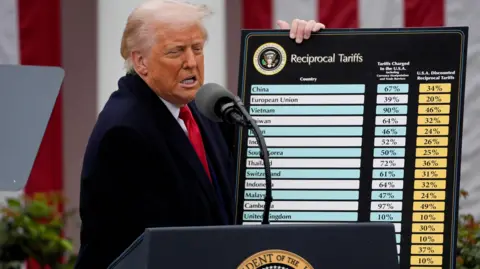
President Donald Trump's use of sweeping tariffs faced sharp questioning at the Supreme Court on Wednesday, in a case with major implications for the president's agenda and the global economy.
A majority of justices, including several conservatives, expressed doubts about the White House's justification of the import duties, which the president has said are necessary to restore America's manufacturing base and fix its trade imbalance.
The measures are being challenged by a number of small businesses and a group of states, who contend that the president has overstepped his authority in imposing the levies, which act as a tax.
America's top court – which has a 6-3 conservative majority – usually takes months to reach big decisions, but many expect it to move faster in this case, as it represents the first major test of the Trump administration's effort to expand presidential power.
Chief among the questions posed by Justice Amy Coney Barrett was about the broad application of tariffs. And so is it your contention that every country needed to be tariffed because of threats to the defense and industrial base? I mean, Spain? France? Her inquiry stressed the vast ambit these tariffs cover.
Billions of dollars in tariff payments are at stake, and a loss for the Trump administration could lead to complex refund processes. The White House's belief that they were ready with a 'Plan B' further underscores the stakes involved.
Trump has characterized the case as one that could have devastating consequences for the nation, asserting that it holds a critical position in American legal history.
The heart of the arguments relies on a 1977 law, the International Emergency Economic Powers Act (IEEPA), which allows the president to regulate trade in response to an emergency. Trump invoked IEEPA to tax goods from countries he deemed threats to the U.S trade status.
Solicitor General John Sauer defended the administration's use of tariffs under this law, arguing that rejecting them could lead to detrimental economic retaliation from other nations.
As justices dissected the implications of ruling in favor of the administration, Chief Justice John Roberts raised concerns over the potential precedent it could set, stating that it would allow the president to impose tariffs on any product from any country.
Lawyers for the challenging states argue that tariffs are not included in the terms of the law issued to the president and emphasize that the traditional ability to tax lies with Congress. The future of these tariffs may hinge not only on their legality but what it signals about the balance of power in U.S. governance.
The hearing attracted significant attention, indicative of the billions in trade revenue at risk and may redefine the limitations of executive power when it comes to economic measures.
As the nation waits for the court’s decision, small businesses across the country anxiously monitor the impact of these tariffs on their operations and the potential for refunds on tariffs already paid.