As they strolled through Tiananmen Square in Beijing last September, Chinese President Xi Jinping and Russian President Vladimir Putin appeared to muse over the possibility that organ transplants could dramatically extend human life.
Human organs can be continuously transplanted. The longer you live, the younger you become, and even achieve immortality, Putin's interpreter was heard saying.
Some predict that in this century, humans may live up to 150 years old, Xi's interpreter was heard responding.
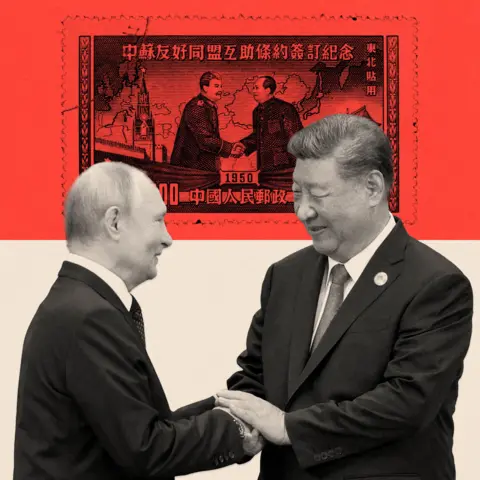
This was a fitting conversation for two strongmen who have described each other as best friends, showing no signs of stepping down after a combined 39 years in power. It reveals a glimpse into a highly secretive relationship that has often been portrayed simplistically by outsiders.
Putin's return to Beijing coincides with the 25th anniversary of the Treaty of Good-Neighbourliness and Friendly Cooperation between Russia and China. The dynamics of their partnership are crucial to understanding their geopolitical strategies.
Trade remains the cornerstone of their relationship, with China being Russia's largest trading partner, while Russia contributes a modest 4% to China's international trade. Years of western sanctions have pushed Moscow deeper into trade engagement with Beijing, making it increasingly reliant on Chinese technology and expertise, particularly in telecommunications.
Amid the backdrop of the ongoing Ukraine conflict, the dependency on Chinese components for Russia's military tech has escalated. However, Russian leaders express wariness of becoming a subservient partner, insisting on preserving their status as a major global power.
The flexibly strategic partnership between China and Russia allows them to support each other's interests without the constraints of a formal alliance, although analysts point out that the imbalance in economic strength heavily favors China.
Despite potential future divergences in strategic aims, both nations recognize their partnership as vital in a chaotic global landscape, one where maintaining a united front against Western hegemony serves simultaneous interests.
The relationship is not just political but has greatly encompassed the cultural and people-to-people exchanges. While political leaders strive to project camaraderie, the personal connections, economic interdependency, and mutual objectives of both countries suggest a partnership designed more for resilience than romanticized notions of friendship.
Yet, as geopolitical winds shift, analysts remain cautious about the future of Sino-Russian relations, emphasizing the pragmatism that defines their partnership amidst the pressures exerted by the West.