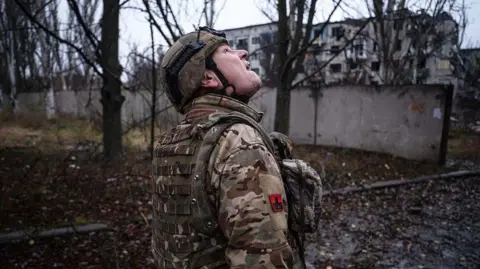
After 225 days stuck in a front-line foxhole, the Ukrainian infantryman's muscles were so weak he could barely walk. His commanders had tried five times to swap him with another soldier - but they could never reach him. Rotating soldiers on the front line in eastern Ukraine is extremely difficult because of the constant threat of drones.
This area near Kostyantynivka is currently one of the most dangerous hotspots and the Ukrainian military admits that Russian forces have reached its outskirts. Kenya, the infantryman, took two days to walk 11km (6.8 miles) to get back to his brigade, avoiding mines and hiding from drones to get out.
Ukraine's 93rd brigade is tasked with defending Kostyantynivka and its surrounding towns and villages. If this highly strategic city falls, Moscow will be able to push towards the last remaining Ukrainian strongholds in the Donbas region – Kramatorsk and Sloviansk – from the north, east, and south.
Vladimir Putin sees the capture of the Donbas as Russia's 'priority goal', and Ukrainian intelligence says he wants it done this year. President Volodymyr Zelensky believes the Kremlin is planning another major offensive in the summer. However, Russia's campaign has lately become bogged down in the region.
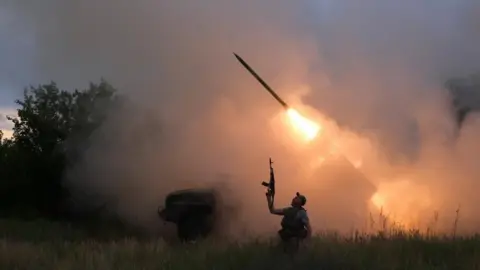
Moscow gained half as much territory in the Donbas in April than in March and a sixth of what it captured in December 2025. Kenya’s task was to maintain his position and listen for any movement outside, with engagement only when Russian troops tried to move against them. Most fighting is done by drones, transforming how wars are fought.
The reliance on speed over armor in this drone-dominated 'kill-zone' illustrates the paradox of modern warfare: while machines increasingly replace humans on the front line, the need for troops remains critical in securing control over territory. In this precarious environment, every outing is a gamble for survival against both enemy combatants and the relentless surveillance of drones.
Soldiers like Kenya and his comrades share harrowing experiences that underline the risks faced by ground troops in the face of sophisticated drone technology. Their biggest fear is being seen by Russian forces, as detection can lead to immediate reprisals. With supplies dwindling and conditions deteriorating, the struggle for survival continues against a backdrop of evolving warfare strategies.