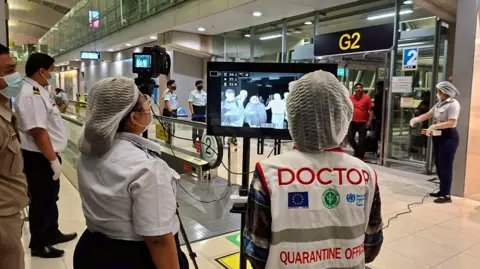
An outbreak of the deadly Nipah virus in India's West Bengal state has sparked concern in parts of Asia, prompting some countries to tighten screening measures at airports.
Thailand has initiated screenings for passengers at three airports that handle flights from West Bengal, while Nepal has started health checks for arrivals in Kathmandu and at other land border crossings with India.
Recently, five healthcare workers in West Bengal were confirmed to be infected with the Nipah virus, with one in critical condition. Health authorities have quarantined approximately 110 individuals who were in close contact with those affected.
The Nipah virus, known for its ability to transmit from animals to humans, has a high fatality rate, ranging from 40% to 75%, and currently, there is no vaccine or specific treatment available.
The virus can be transmitted from animals, such as pigs and fruit bats, to humans and can also spread through contaminated food. The World Health Organization categorizes Nipah as one of the top ten priority diseases, highlighting its epidemic potential.
The symptoms manifest after an incubation period of four to 14 days, beginning with indicators like fever, headaches, and muscle pain. In severe cases, it may lead to encephalitis, which inflames the brain.
The initial Nipah outbreak occurred in Malaysia in 1998, resulting in significant fatalities and economic losses. Since then, Bangladesh has reported numerous cases resembling the current outbreak, with India's West Bengal and Kerala states also facing Nipah challenges.
This latest outbreak has raised alarms among neighboring countries, leading to preemptive measures aimed at containing potential spillover effects; for instance, Thailand has implemented health declarations for arriving passengers and stricter checks at tourist sites.
In Taiwan, authorities are considering classifying the Nipah virus as a 'Category 5 disease', indicative of emerging infections that pose major public health risks which necessitate immediate reporting and control measures.
Authorities across Asia reiterate their commitment to monitoring and controlling the situation closely to prevent future outbreaks.