In brief
On November 1, 2026, DEWA International and Shanghai Electric signed a Memorandum of Understanding to cooperate on energy, water, and green technology projects worldwide. The agreement will guide joint development and investment in combined‑cycle power plants, solar and wind power, battery storage, desalination, and green hydrogen and ammonia production. The partnership aims to strengthen DEWAs global presence and support sustainable infrastructure.
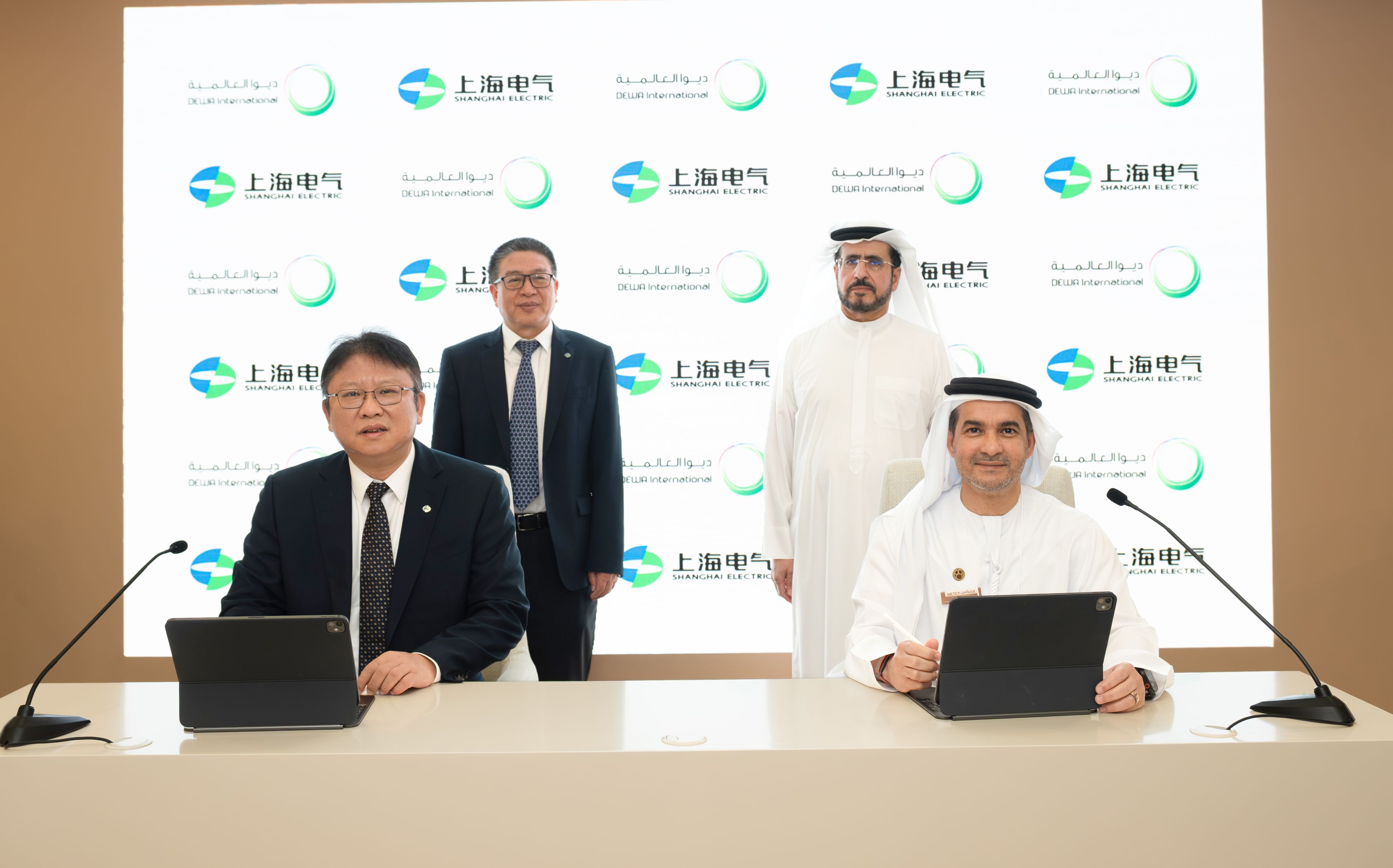
A Memorandum of Understanding (MoU) signed on November 1, 2026, formalises a partnership between DEWA International, the global arm of Dubai Electricity and Water Authority (DEWA), and Shanghai Electric. The agreement, witnessed by DEWA International’s Managing Director & CEO Saeed Mohammed Al Tayer, outlines a framework for joint exploration and investment in energy, water, and infrastructure projects across markets worldwide.
The signing ceremony saw key executives from both organisations, including Executive Vice President of Business Development and Excellence at DEWA, Waleed bin Salman; President of Shanghai Electric Power Generation Group, Shen Bing; and Vice President of Shanghai Electric Group, Jin Xiaolong. All were present in Dubai’s Al Jaber Square, underscoring the strategic importance of the partnership to the UAE and China.
At its core, the MoU establishes a systematic process for joint project identification, evaluation, development, and structuring. The texts describe a staged approach: initial market screening, feasibility studies, technical design, financial modelling, and eventual tender participation or direct investment. This structure mirrors best practices in project finance and aligns with DEWA’s global expansion strategy outlined by Al Tayer in a post‑signature statement.
Al Tayer emphasized that the partnership would leverage "Dubai’s pioneering expertise in the utilities sector and the global capabilities of our partners." He added that the deal would “support our efforts to explore promising opportunities in energy, water and green technologies and develop sustainable and commercially viable projects that contribute to the global transition to more efficient and sustainable energy systems.”
N/A
While the MoU contains many high‑level objectives, it specifically lists technical domains where the two parties will collaborate. These include:
Technical Collaboration Areas
Combined‑cycle power plants, which integrate gas and steam turbines to generate electricity more efficiently than conventional plants, are highlighted as a priority. The MoU indicates that both organisations will jointly design, finance, and build such facilities.
Solar technologies encompass both photovoltaic (PV) panels that convert sunlight directly into electricity and concentrated solar power (CSP) systems that use mirrors to focus sunlight onto a focal point to generate heat and subsequently steam for electricity. These technologies offer complementary strengths: PV for distributed generation and CSP for thermal energy storage.
Battery energy storage systems (BESS) are expected to receive joint attention. BESS store excess electricity produced during low‑demand periods and release it during peak demand, smoothing supply curves and enhancing grid stability.
Wind energy projects will adhere to traditional turbine deployment models across varying wind profiles. Both partners will exercise joint investment in siting, permitting, and technology selection to optimise power output.
Seawater desalination, a process that removes salt from ocean water to produce potable supply, will be another focal area. The parties will assess fresh‑water demand, plant scalability, and integration with renewable energy sources.
Electricity transmission and distribution will also feature under the MoU. This includes modernising grids to accommodate variable renewable outputs and ensure safe, reliable delivery to end consumers.
Green hydrogen and green ammonia production represent the most ambitious segments of the agreement. Green hydrogen refers to hydrogen generated via electrolysis powered by renewable electricity, without carbon emissions. Green ammonia, derived from green hydrogen through the Haber‑Bosch process, serves as a low‑carbon fuel and chemical feedstock.
In addition, the MoU covers supply of equipment and related services for the oil and gas sector, allowing the partnership to diversify beyond green projects and support traditional energy infrastructure needs.
Each sector’s selection reflects an integrated energy‑water nexus strategy, a framework increasingly adopted by utilities to improve operational efficiency and resilience. By coupling power generation with desalination and water treatment, the partnership aims to create synergies that reduce overall operational costs.
From a research perspective, the MoU opens opportunities for multi‑disciplinary collaboration between engineering, economics, and environmental science teams. The joint involvement of a government‑owned utility and a multinational industrial service provider is expected to accelerate technology transfer and expedite commercialization timelines.
The agreement also provides a platform for future joint research into emerging storage modalities, such as advanced lithium‑ion chemistries and flow batteries, which could be integrated with green hydrogen infrastructure to create a unified low‑carbon energy ecosystem.
While the MoU marks a significant strategic step, it remains a framework agreement rather than a definitive project contract. Consequently, the parties are expected to negotiate funding arrangements, ownership structures, and regulatory compliance for individual ventures on a case‑by‑case basis.
For DEWA International, the MoU will serve as a lever to strengthen its global footprint, especially in China where Shanghai Electric holds a dominant market presence. Conversely, Shanghai Electric will benefit from DEWA’s deep water infrastructure experience and its global capacity to secure large‑scale contracts.
In their post‑signature comments, both Ms. Al Tayer and Mr. Shen underscored the intent to deliver projects that not only meet commercial viability but also align with international decarbonisation goals. The partnership will therefore contribute to the United Nations Sustainable Development Goals of affordable and clean energy (Goal 7) and sustainable cities and communities (Goal 11).
In summary, the DEWA International and Shanghai Electric MoU establishes a structured cooperation path across multiple renewable and water sectors. With emphasis on combined‑cycle power, solar and wind generation, battery storage, desalination, and green hydrogen production, the partnership reflects a multi‑modal, data‑driven approach to addressing global energy and water challenges.