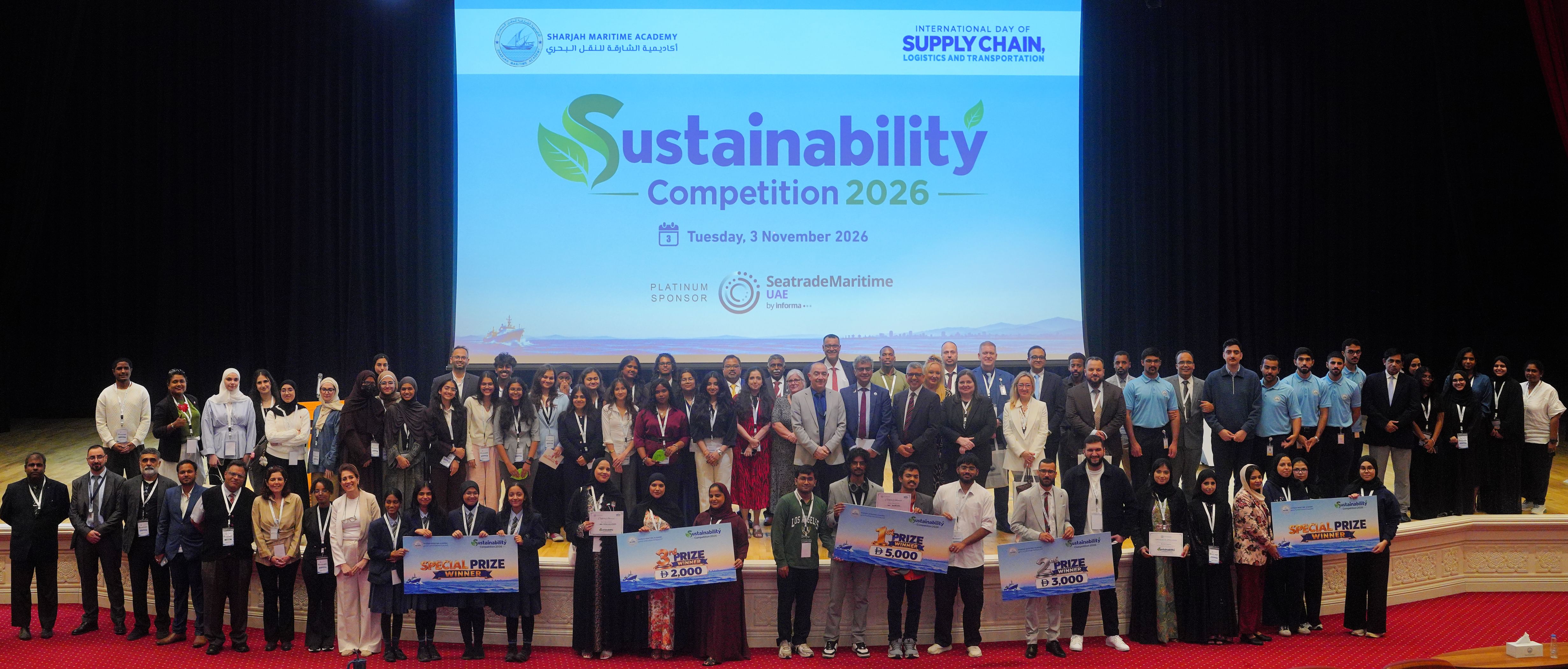
On 5 November 2026, Sharjah Maritime Academy (SMA) held its inaugural Sustainability Competition in Sharjah, coinciding with the International Day of Supply Chain, Logistics and Transportation. The event gathered 115 students from 16 higher‑education institutions across the United Arab Emirates to present 35 innovative projects addressing environmental and industrial challenges in maritime transport, smart ports, renewable energy, artificial intelligence, marine conservation and the circular economy.
According to WAM, the competition was organized under the theme "From Classroom Innovation to Real-World Sustainability: Empowering the Next Generation to Shape a Greener Future". The goal was to strengthen the link between academic training and practical applications that meet labour‑market needs, while advancing the UAE’s Net’2050 strategic initiative to achieve carbon neutrality by the year 2050. Net Zero means reducing greenhouse‑gas emissions to a balance of zero, either by cutting emissions or offsetting them through environmental projects.
The event received industry backing, with Seatrade Maritime acting as Platinum Partner to showcase the importance of academia‑industry collaboration in pushing maritime sustainability forward. At the ceremony, Dr. Hashim Abdullah Bin Sarhan Al Zaabi, Chancellor of SMA, remarked that education must move beyond knowledge acquisition toward creating practical solutions. In a statement, he said, "At Sharjah Maritime Academy, we believe that education must go beyond knowledge acquisition to empower students to develop practical solutions…"
Keynote speakers highlighted emerging trends in the sector. Ravi Shankar, Chairman of the Institute of Chartered Shipbrokers (ICS) Middle East, emphasized the need for resilient supply chains and the growing importance of sustainability.
Key industry trends include stronger regulatory frameworks, greater use of data analytics and the shift toward low‑carbon shipping routes.
Ravi Shankar noted that "strengthening sustainability and supply chain resilience" is essential for the maritime sector’s future.
The competition project pool displayed a range of cutting‑edge technologies. One highlighted innovation was an AI-powered ocean protection system. Artificial intelligence, or AI, refers to computational techniques that enable machines to learn from data and make decisions, often used to process large amounts of marine sensor data.
Another set of projects explored marine debris collection robots, designed to autonomously remove plastic and other pollutants from the water. The objective of these robots is to combine mechanical engineering with autonomous navigation so that they can operate in diverse sea conditions.
Microplastic filtration solutions were also presented. These devices aim to capture microscopic plastic particles that survive traditional wastewater treatment, thereby protecting marine ecosystems from toxic pollution. In addition, a solar‑powered maritime infrastructure project showcased how photovoltaic panels can be integrated into offshore platforms to supply clean electricity for operations.
Sustainable aquaculture projects focused on closed‑loop systems that reuse water and minimize feed waste. By reducing the environmental footprint of fish farming, these initiatives support food security while protecting marine habitats.
The waste‑to‑energy projects illustrated how marine waste streams could be converted into biogas or electricity. Through anaerobic digestion and combustion, these technologies aim to harvest energy from refuse that would otherwise end up in the ocean.
Students from a broad spectrum of institutions participated. Higher education schools represented included Khalifa University, United Arab Emirates University, Higher Colleges of Technology, University of Sharjah, University of Dubai, Abu Dhabi University, Abu Dhabi Polytechnic, Amity University Dubai, Hamdan bin Mohammed Smart University, University of Wollongong Dubai, and Sharjah Maritime Academy itself. Three primary‑school partners—Ajman American Private School, International Indian School Abu Dhabi and JSS Private School—also showcased their students’ projects, indicating a growing interest in sustainability science across all ages.
The event’s agenda reflected several themes: the integration of data analytics in maritime logistics, the application of AI to ocean monitoring, and the promotion of a circular economy model. A circular economy describes economic systems where resources are reused, repaired, remanufactured and recycled, thereby minimizing waste and reducing the need for new raw materials.
Stakeholders praised the competition for providing a platform where theoretical concepts learned in lecture halls can be translated into tangible solutions that benefit the maritime industry. The alignment with the UAE Net Zero 2050 initiative ensures that the projects also contribute toward national climate goals, offering a realistic pathway for achieving emissions reduction targets in a sector historically heavy on fossil fuels.
As the first edition of the SMA Sustainability Competition, the gathering set a benchmark for academic‑industry partnerships in the Gulf region. Future competitions are expected to broaden participation, incorporate more interdisciplinary research, and foster stronger ties between local universities, industrial partners and government agencies dedicated to maritime sustainability.