In brief
After nearly two millennia, advanced techniques are beginning to reveal the secrets of a scroll scorched by the eruption of Mount Vesuvius in 79AD.
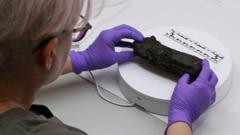
Scientists have made significant strides in unveiling an ancient scroll from Herculaneum, a Roman town decimated by the catastrophic eruption of Mount Vesuvius nearly 2,000 years ago. Through cutting-edge X-ray imaging and artificial intelligence, the team has successfully digitally "unwrapped" the scroll, providing a glimpse into its charred interior, which previously appeared to be a formless lump of charcoal. The scroll, damaged beyond conventional restoration methods, remains too delicate to be opened physically. However, researchers involved in the Vesuvius Challenge project—an international effort aimed at deciphering the burnt documents—are optimistic about their findings. Stephen Parsons, the project leader, expressed confidence that they would be able to read a large portion of the scroll, claiming, “We’re confident we will be able to read pretty much the whole scroll in its entirety.”The ancient manuscript, which is made from papyrus, was discovered among hundreds of carbonized scrolls hidden beneath layers of volcanic ash in Herculaneum. Previous attempts to unroll similar scrolls often resulted in fragmentary remains. Hence, these documents remained neglected for decades in the Bodleian Library at Oxford. Nicole Gilroy, head of book conservation, remarked on past doubts regarding the effectiveness of any existing techniques: “We've never been convinced before that any of the techniques would be safe enough or effective enough to get any information from the scrolls.”The breakthrough came when the team transported one of the precious scrolls to Diamond Light Source in Oxfordshire. Utilizing a synchrotron—a powerful facility where electrons are accelerated to near-light speeds to generate high-energy X-rays—researchers are able to probe the scroll non-destructively. Adrian Mancuso, director of physical sciences at Diamond, elaborated on their method, noting, "It can see things on the scale of a few thousandths of a millimeter.”The scanning process produces a three-dimensional reconstruction of the scroll, enabling researchers to identify and digitally unroll its multiple layers, which collectively measure about 10 meters of papyrus. As the scroll's structure is examined, AI technology is employed to discern the ink, as both the papyrus and ink utilize carbon, which renders them almost indistinguishable from one another. The AI searches for subtle indications of ink and digitally enhances the text.Currently, experts have established that the scroll contains extensive text, and the aim is to enhance its visibility. Last year, the Vesuvius Challenge team identified around 5% of another Herculaneum scroll, revealing themes of Greek Epicurean philosophy, which espouses finding joy in everyday pleasures. The newly investigated scroll is likely to delve into similar themes.Gilroy underscored the human connection involved in this work, stating, “There’s a real human aspect to it that I just think is really precious.” The ongoing efforts not only brighten the prospects of understanding ancient philosophical thought but also bridge a connection to those who meticulously preserved these works, allowing modern scholars a rare opportunity to engage with history.